Prevent Patient Elopement Before Someone Leaves the Facility
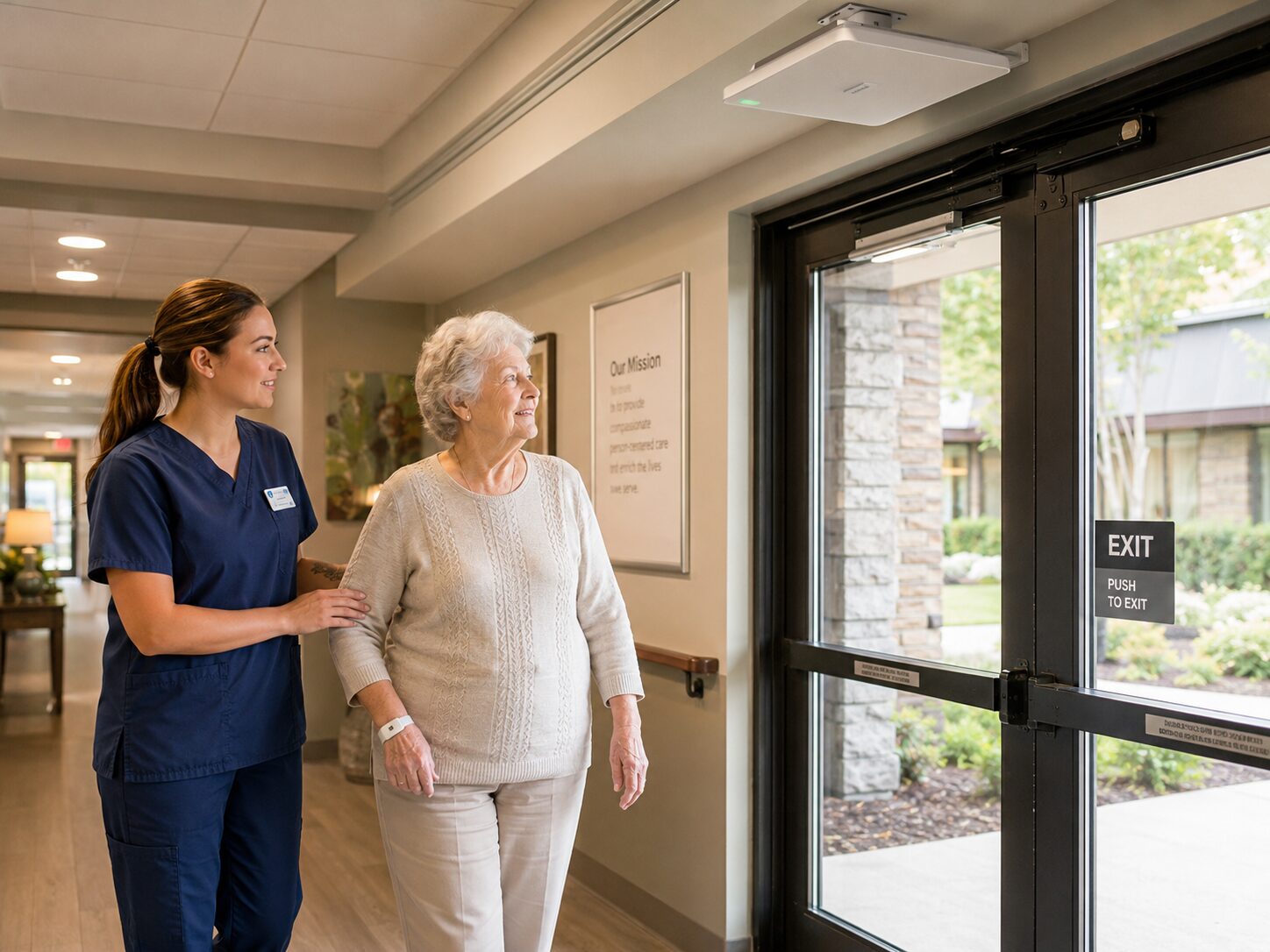
A wander management system automatically detects an assigned patient or resident approaching a monitored exit and alerts staff while there is still time to respond.
Fresh USA provides a practical patient elopement prevention system for hospitals, memory care, assisted living, skilled nursing and senior care facilities. The solution can combine patient or resident tags, overhead exit readers, local audible and visual alarms, optional mobile notifications and searchable event records.
No manual scan is required at the doorway. When an assigned tag enters the configured exit zone, the system detects the event automatically so caregivers, reception personnel or security staff can follow the facility’s response procedure.
The Fresh USA Wander Management System can begin with one high-risk doorway and expand to additional exits as operational requirements grow.
Configure Your Wander Management System
Request a Wander Management System Quote
A Wander Management System Built Around the Moment of Risk
Wandering inside a healthcare facility and actually leaving a supervised area are not the same event.
A patient or resident may move normally through hallways, activity areas or approved departments. The critical moment occurs when an at-risk person approaches an exterior door, stairwell, parking connection or another transition from a supervised area to an unrestricted location.
A properly designed wander management system focuses on that moment.
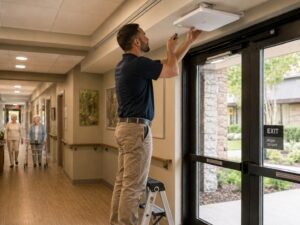
The wander management system can help staff identify an assigned at-risk person approaching:
- An exterior entrance or exit
- An emergency department doorway
- A behavioral health unit exit
- A parking garage connection
- A stairwell
- An elevator leading to an unrestricted area
- A loading or service entrance
- A transition between controlled and public areas
Instead of discovering that someone is missing after the person has already left, staff receive an automatic warning at the point where intervention may still be possible.
How the Wander Management System Works
The Fresh USA wander management system follows a straightforward exit-monitoring process.
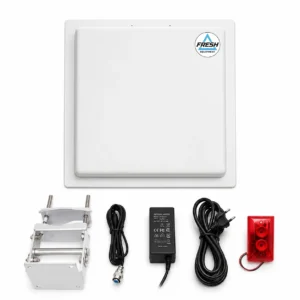
- A compatible tag is assigned to the patient or resident who requires exit monitoring.
- An overhead reader is installed at the selected doorway or controlled transition point.
- The reader continuously monitors the configured detection zone.
- When the assigned tag approaches or passes through the monitored area, the reader detects it automatically.
- A local audible or visual alarm can activate immediately.
- Optional wireless notification equipment can alert designated staff away from the doorway.
- Optional software can identify the registered tag and create a searchable event record.
- Caregivers, reception personnel or security staff follow the facility’s established response procedure.
Staff do not need to stop every person and scan a wristband manually. The wander management system performs the detection automatically at the monitored doorway.
The objective of the wander management system is to preserve normal movement within approved areas while providing an early warning when an assigned at-risk person reaches a monitored exit.
Wander Management System Components
A complete wander management system is more than a single reader. The project is built from several components selected according to the facility layout and required response procedure.
Patient or Resident Tag
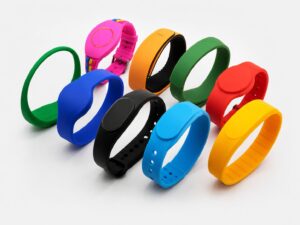
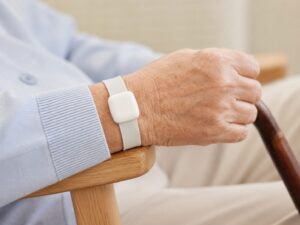
A unique tag is assigned to the person requiring monitoring. Depending on the wander management system design and approved facility procedure, the tag may be configured as a wristband, badge, pendant-style device or another tested wearable arrangement.
Overhead Exit Reader
The fixed reader monitors the selected doorway or transition zone and automatically recognizes assigned tags entering its configured detection field.
Local Audible or Visual Alarm
A stand-alone installation can activate an alarm near the exit so nearby personnel are immediately aware of the event.
Optional Mobile Notification
A compatible wireless alarm notification system can provide alerts through an available Wi-Fi connection or cellular service when responsible staff are located away from the doorway.
Optional Wander Management Software
Compatible software can register assigned tags, identify which tag generated an event, monitor multiple readers and maintain searchable detection records and reports.
Facilities can select only the wander management system components required for the initial project and expand the system later.
Configure a Wander Management System for Your Facility
Every wander management system should be configured around the actual facility layout, monitored exits, patient or resident population and required staff response procedure.
Use the Fresh USA System Configurator to build a preliminary configuration and compare the equipment, alarm and optional software functions that may be appropriate for your project.
Open the Fresh USA System Configurator
Request a Wander Management System Quote
Patient Elopement Prevention for Hospitals
Patient elopement prevention is a significant operational concern whenever a patient who requires supervision may leave a controlled treatment area without authorization or required staff assistance.
Hospitals manage patients with very different levels of mobility, awareness and supervision. Elopement risk may be associated with:
- Dementia or cognitive impairment
- Temporary confusion or disorientation
- Altered mental status
- Medication effects
- Neurological conditions
- Behavioral health conditions
- Disorientation after treatment
- Communication difficulties
- A patient attempting to leave before discharge
A hospital wander management system can monitor selected high-risk transition areas without requiring a building-wide tracking infrastructure.
Potential hospital monitoring locations include:
- Emergency department exits
- Behavioral health unit exits
- Patient discharge doors
- Main entrances
- Elevator lobbies
- Stairwell doors
- Parking garage connections
- Rehabilitation unit exits
- Connections between controlled and public areas
The wander management system provides an additional layer of awareness at the doorway. It does not replace clinical assessment, required observation levels, staff supervision or the hospital’s approved security and response procedures.
Resident Wander Management for Memory Care and Senior Living
Memory care and senior living communities face a different challenge: protecting residents at risk of wandering while preserving dignity, mobility and a comfortable living environment.
A resident wander management system can allow residents to move normally through approved areas while monitoring selected exterior doors and transition points.
When an assigned resident approaches a monitored exit, the wander management system alerts staff so they can respond according to the resident’s care plan and the facility’s procedure.
The wander management system can support facilities caring for residents living with:
- Alzheimer’s disease
- Dementia
- Memory loss
- Cognitive decline
- Disorientation
- Impaired recognition of surroundings
This makes the solution suitable for:
- Memory care communities
- Assisted living facilities
- Senior living communities
- Skilled nursing facilities
- Nursing homes
- Rehabilitation centers
- Adult day care programs
- Continuing care retirement communities
Only residents identified by the facility as requiring exit monitoring need to participate in the wander management system.
Automatic Exit Alerts Give Staff Time to Respond
A wander management system supports patient elopement prevention by creating an actionable alert when an assigned person reaches a monitored doorway, giving responsible staff time to respond.
Local Audible and Visual Alarm
A stand-alone configuration can activate an audible alarm, warning light or other compatible notification near the monitored exit.
This may be appropriate when:
- Reception personnel are located near the doorway
- A nurse station can hear the alarm
- Security staff continuously monitor the entrance
- A local response is sufficient
Patient or Resident Identification
When compatible software is used and the tag is registered, the wander management system can associate the detected tag identifier with the corresponding facility-created patient or resident entry.
This helps staff determine which assigned person triggered the doorway event.
Mobile Alarm Notification
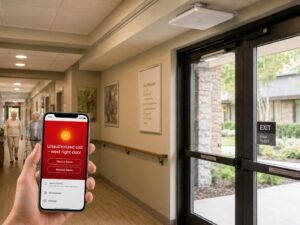
An optional wireless notification system can use an available Wi-Fi connection or compatible cellular service to provide alerts when responsible personnel are located away from the monitored exit.
This can be useful when:
- The doorway is not continuously visible
- Caregivers move throughout the facility
- Security personnel are located remotely
- Multiple employees may need notification
- A local siren alone does not provide adequate response coverage
A compatible SIM card and cellular service plan may be required when cellular communication is selected.
View the Wireless Alarm Notification System
Overhead Exit Monitoring Keeps Doorways Open and Accessible
A wander management system reader can be installed above or near the monitored doorway rather than placing large floor-standing antenna gates on both sides of the entrance.
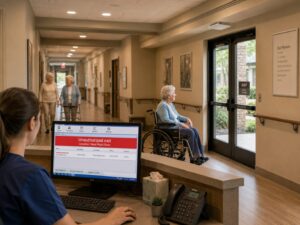
This approach helps preserve normal access for:
- Patients and residents
- Wheelchairs and walkers
- Hospital beds and stretchers
- Clinical staff
- Visitors
- Emergency movement
- Patient transport and discharge activity
The final wander management system reader location depends on doorway width, ceiling height, surrounding construction, nearby metal structures and the required detection zone.
Every wander management system installation must be tested with the actual doorway and the tag configuration intended for patients or residents.
Wearable Patient and Resident Tag Options
Tag selection is an important part of any wander management system because the tag must work reliably in the real care environment.
Depending on the project, a compatible tag may be assigned as:
- A wearable wristband
- An identification badge
- A pendant-style tag
- A tag attached to approved personal equipment
- Another facility-approved wearable configuration
Each tag has a unique identifier. The tag itself does not need to display unnecessary personal or medical information.
Passive tag options can operate without individual charging or routine battery replacement. Passive tags receive energy when they enter the compatible reader’s detection field.

Detection performance depends on:
- Tag design
- Wearable position
- Tag orientation
- Clothing and surrounding materials
- Reader position
- Doorway width
- Nearby walls and metal structures
- The required detection zone
The actual wander management system tag configuration should always be tested before final deployment.
Stand-Alone Wander Management or Software-Based Monitoring
Not every facility requires the same wander management system configuration or level of complexity.
Stand-Alone Exit Alarm
A smaller facility or a single monitored doorway may use a stand-alone wander management system configuration that detects the assigned tag and activates a local alarm without requiring a central computer database.
Wander Management Software and Event Records
Facilities requiring identification, multiple-reader management and event history can add compatible Windows software.
Depending on the configuration, software functions may include:
- Registration of patient and resident tags
- Assignment of internal identification information
- Searchable reader event history
- Detection records by monitored exit
- Monitoring of multiple readers
- Reader status and connection management
- Reports based on recorded events
The wander management system software configuration depends on the number of monitored exits, readers and workstations required by the facility.
The patient wandering system identifies assigned tags rather than analyzing faces. Standard exit monitoring does not require facial recognition or continuous video identification.
Patient or resident information stored in the wander management system should be limited to the information the facility requires for operational response.
Wander Management System vs. Real-Time Patient Tracking
The terms wander management system, wander tracking system and patient tracking are sometimes used for different technologies.
Exit-Focused Wander Management
The Fresh USA wander management system detects an assigned patient or resident tag at a selected doorway or controlled transition area.
It answers a direct operational question:
Is this assigned at-risk person approaching a monitored exit?
This is a practical approach when the primary requirement is patient elopement prevention rather than continuous location throughout the entire facility.
Full-Building Real-Time Location Tracking
A real-time location system is designed to estimate a person’s location throughout multiple rooms, departments or floors.
This normally requires additional locating infrastructure, mapping, network planning and a different system architecture.
GPS Tracking
GPS technology is generally intended to help locate a person after the person is outdoors or away from the facility. That is different from an indoor exit alert designed to warn staff before or while an unauthorized departure is occurring.
A facility that primarily requires doorway alerts should not be forced into a more complex building-wide tracking project than its workflow requires.
Authorized Patient and Resident Movement
A wander management system used for patient elopement prevention must also accommodate legitimate movement through monitored exits.
Authorized movement may include:
- Medical appointments
- Hospital discharge
- Transportation
- Outdoor activities
- Family visits
- Emergency evacuation
- Transfers between buildings
The authorized movement procedure should be defined during system planning.
Depending on the facility, this may involve a staffed exit, temporary alarm-management procedure, tag reassignment or removal by authorized personnel, software status change or documented escort procedure.
The wander management system should support the facility’s approved workflow without creating unnecessary delays during legitimate patient or resident movement.
Start with the Highest-Risk Exit and Expand
A facility does not need to install a complete campus-wide wander management system on the first day.
The initial phase can focus on:
- One main entrance
- One memory care exit
- One emergency department doorway
- One behavioral health unit exit
- One parking garage connection
- One senior living reception area
After the initial configuration is tested, the facility can add:
- Additional monitored exits
- Additional patient or resident tags
- Wireless notifications
- Software event records
- Additional reader connections
This phased approach allows the organization to address its highest-priority elopement risk first and expand based on actual operating experience.
Request a Wander Management System Recommendation
Planning a Wander Management System
Every wander management system project must account for the facility’s building layout, patient or resident population and response procedure.
To prepare a wander management system recommendation, please provide:
- Facility name and installation address
- Type of healthcare or senior care facility
- Number of patients or residents requiring monitoring
- Number of exits to be monitored
- Doorway width and ceiling height
- Photographs of each proposed monitoring location
- A basic floor plan showing nearby corridors when available
- Available electrical power
- Available Ethernet or Wi-Fi connection
- Whether a local audible or visual alarm is required
- Whether mobile notifications are required
- Whether software event records and reports are required
- Where responding staff are normally located
- How authorized patient or resident movement is currently handled
Based on this information, Fresh USA can recommend the reader location, number of monitored exits, tag configuration and optional software or wireless notification components.
Installation, Testing and Technical Support
A qualified local low-voltage, security or electrical contractor can normally complete the physical wander management system installation.
Fresh USA provides technical documentation and remote assistance with:
- Reader configuration
- Detection-zone adjustment
- Patient or resident tag testing
- Alarm connection guidance
- Wireless notification setup
- Software installation
- Reader connection
- Event testing
- System expansion planning
Final testing should use the actual doorway, reader location, wearable configuration and movement patterns expected at the facility.
An Additional Safety Layer — Not a Replacement for Patient Care
A wander management system for patient elopement prevention provides an additional layer of awareness at selected exits.
It does not replace:
- Clinical assessment
- Professional care
- Required patient observation
- Resident care plans
- Staff supervision
- Facility security procedures
- Approved access-control procedures
- Emergency response policies
The wander management system detects an assigned tag in a configured monitoring zone and activates the selected alert. Staff response remains an essential part of the facility’s safety procedure.
Part of a Complete Healthcare and Senior Care Safety Strategy
The Fresh USA Wander Management System can operate as an independent solution or as part of a wider healthcare technology project.
Fresh USA also provides solutions for:
- Hospital asset tracking
- Wheelchair and mobility equipment tracking
- Medical equipment inventory
- Healthcare uniform management
- Automated uniform conveyor storage
- Restricted-area access control
- Employee and parking access
- Equipment theft prevention
Explore Healthcare and Senior Care Solutions
View Hospital Asset Tracking Solutions
Frequently Asked Questions
What is a wander management system?
A wander management system monitors assigned patients or residents at selected exits. When an assigned tag enters the configured doorway zone, the system activates an alert so staff can respond before an unauthorized departure progresses further.
What is patient elopement prevention?
Patient elopement prevention includes the procedures and technologies used to reduce the risk of an at-risk patient leaving a supervised or controlled care area without authorization or required staff assistance.
How does a patient wandering system work?
An assigned patient or resident wears a compatible tag. A reader monitors the selected doorway, detects the assigned tag entering the configured exit zone and activates the selected local, mobile or software-based alert.
Is this a wander tracking system?
Yes. It is an exit-focused wander tracking and management system for assigned patients and residents. It monitors selected doorways rather than continuously displaying every person’s room-by-room location throughout the building.
Can the system be used for residents with dementia or Alzheimer’s disease?
Yes. The system can be configured to monitor assigned residents living with dementia, Alzheimer’s disease, memory loss, cognitive decline or disorientation at selected exits.
Can the system be used in hospitals?
Yes. Potential applications include emergency departments, behavioral health units, rehabilitation departments, patient discharge areas and other controlled hospital exits.
Can the system be used in memory care and assisted living?
Yes. The system can support memory care, assisted living, skilled nursing, nursing homes and other senior care environments.
Does the system track every patient throughout the building?
No. The standard configuration monitors assigned tags at selected doorways or controlled transition areas. Continuous building-wide location requires a separately designed real-time location system.
Does the system require facial recognition?
No. The system detects an assigned tag and does not require facial recognition to identify the exit event.
Does the system physically stop the patient or resident?
No. The standard system activates an alert when the assigned tag enters the monitored zone. Staff response and any separate access-control procedure remain part of the facility’s approved workflow.
Can an alert be sent to a mobile phone?
An optional wireless notification system is available. Wi-Fi availability, cellular coverage and the required notification procedure should be confirmed during project planning.
Can the system identify which patient or resident triggered an alert?
Each tag has a unique identifier. When compatible software is included and the tag is registered, the detected event can be associated with the corresponding facility-created patient or resident entry.
Do patient or resident tags require batteries?
Passive tag options do not require individual charging or routine battery replacement. The correct tag and wearable configuration must be selected and tested for the actual facility environment.
Can we start with one monitored exit?
Yes. A facility can begin with one high-risk doorway and later add more readers, assigned tags, software functions or wireless notification equipment.
What information is required for a wander management system quotation?
Please provide the facility address, type of facility, number of people requiring monitoring, number of exits, doorway photographs and dimensions, ceiling height and the required alarm, software and mobile notification functions.
Protect Patients and Residents Before an Exit Becomes an Emergency
Do not wait until employees are searching hallways, reviewing camera footage or contacting security because an at-risk patient or resident cannot be located.
Start with the doorway where an unauthorized departure presents the greatest risk.
Fresh USA will evaluate the facility layout, patient or resident population, monitored exits, required alerts and staff response procedure. We will then recommend a practical wander management system and patient elopement prevention configuration designed around your actual workflow.