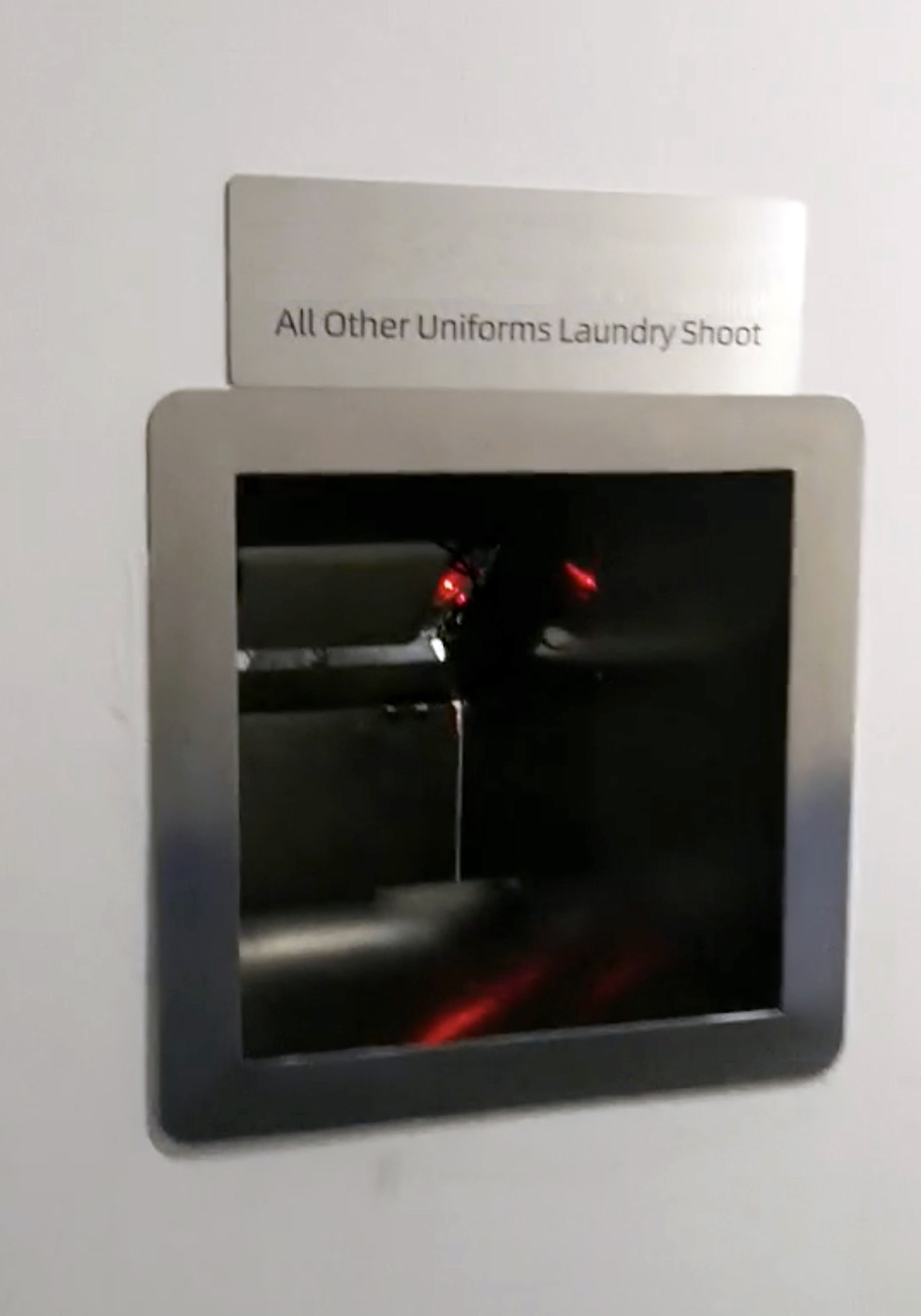
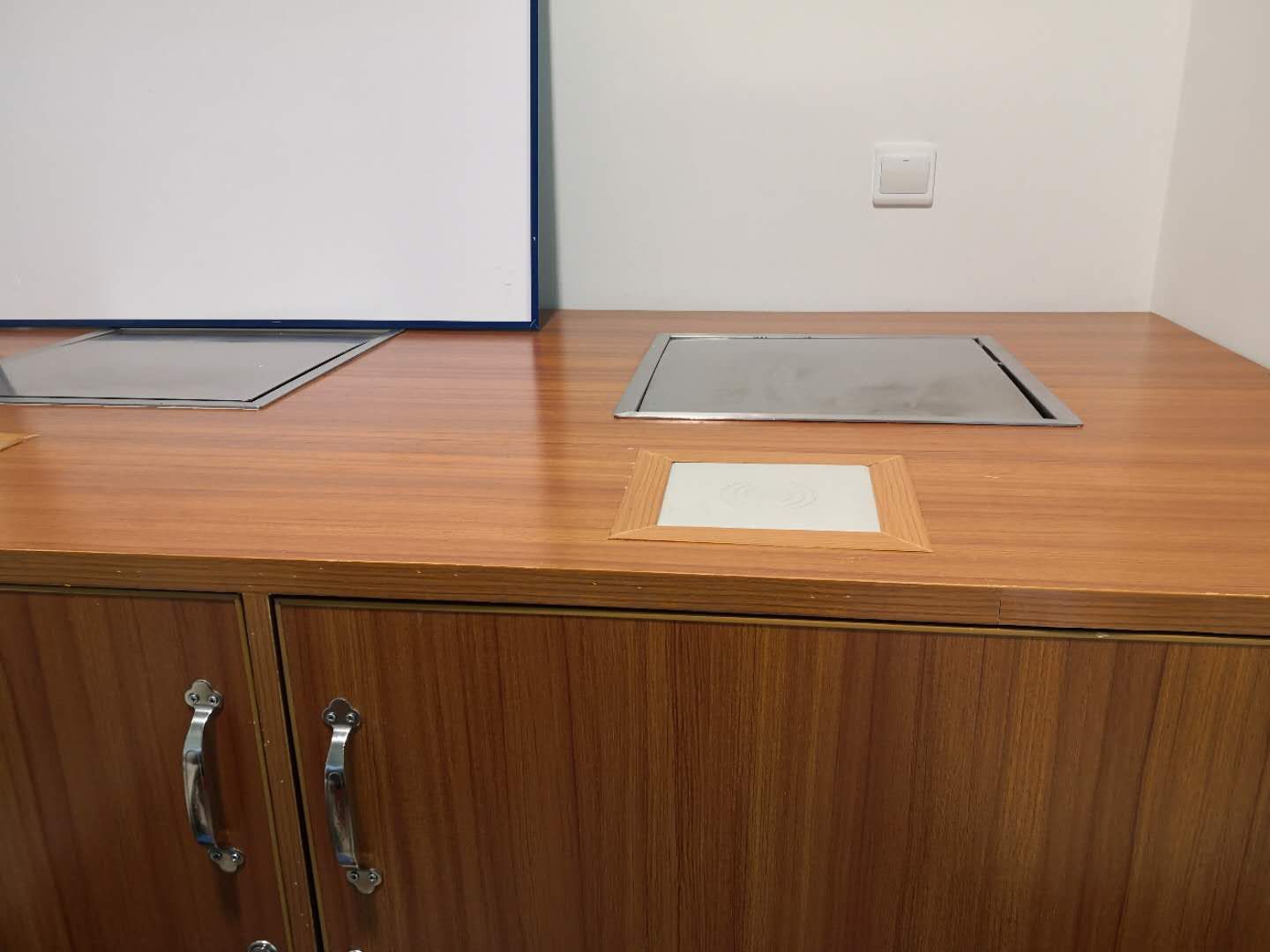
Fresh USA designs and supplies custom uniform conveyor systems for hotels, casinos, healthcare facilities, industrial operations and commercial laundries. Each system is engineered around your available room, garment volume, employee workflow and future expansion requirements.
Our powered garment conveyors help maximize storage capacity, reduce manual searching and improve uniform distribution. Instead of forcing your operation to fit standard equipment, we design the conveyor layout to fit your building.
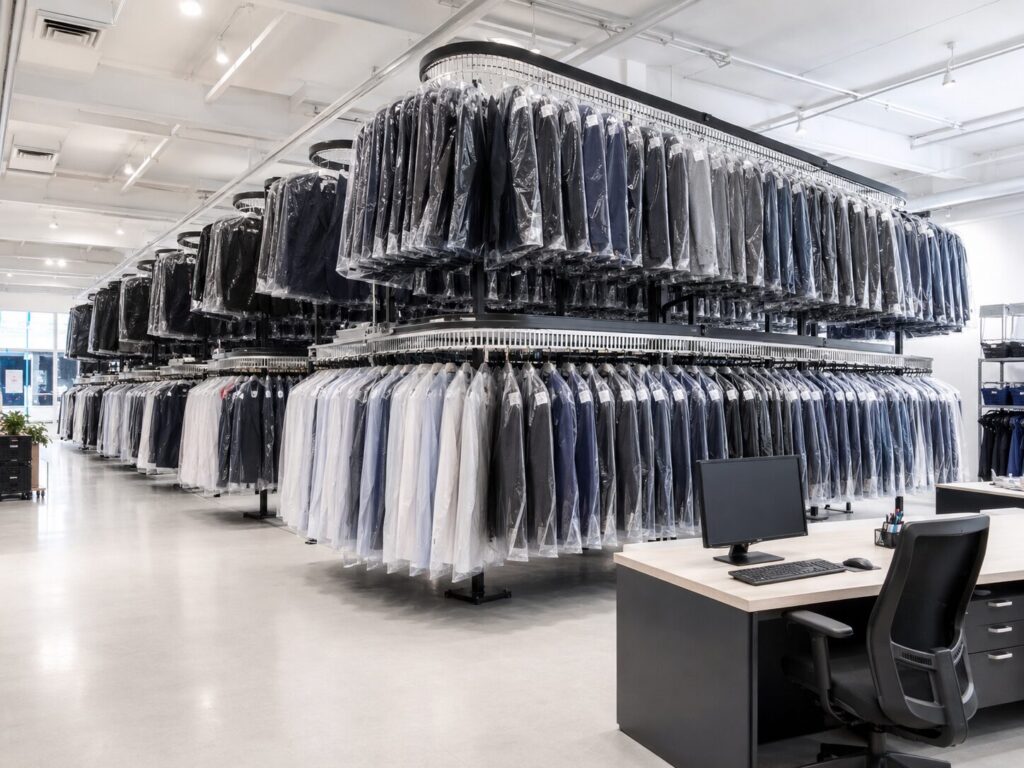
Build a preliminary uniform conveyor configuration for your facility based on the required garment capacity, available room dimensions and preferred conveyor layout. Compare single-level and multi-level storage systems for hotels, casinos, healthcare facilities, industrial operations, commercial laundries and other employee-uniform applications.
Enter the required number of uniforms and select the conveyor layout, controls and optional automation features to calculate an estimated system size and request an exact delivered quote. Size your system, compare layouts, add automation and RFID options, and request an exact delivered quote. Enter the garment capacity you need. Auto mode prioritizes one-conveyor solutions, then the closest capacity and smallest practical footprint. Select the standard layout you prefer. Pricing below follows the selected configuration. Only one additional control/automation system can be installed on each conveyor. RFID Management System is one workstation/system per project. Each item is optional. Quantities follow the package rules shown. Example of a glossy branded RFID numbered card with hanger hole. Full-color branding, custom image/design, and sequential numbering are available. Approx. 16.5 in / 42 cm wide and 7.8 in / 19.8 cm high. See drawing for detailed hook dimensions. These selections are finalized in the quotation and project documentation. Select a recommended configuration to see its height capability. Equipment estimate before delivery, installation, taxes/duties and final site engineering. Your current calculator configuration will be attached automatically.
FRESH USA
Commercial Garment Conveyor Configurator
Included with every conveyor
✓ $9.90 per physical hanging cell✓ Forward / Stop / Backward buttons
✓ Visual numbering of every cell✓ 25 mm / 0.98 in cell pitch, center-to-center
✓ Customer-selected conveyor color✓ Commercial modular construction
1
Storage Requirement
Optional: filter by available room size
Room filters apply only while this section is open. Preliminary fit only; final engineering also considers doors, columns, sprinklers, service access and the longest garments.
2
Recommended Configuration
3
Control & Automation
Uniform Warehouse workflow: RFID-tagged uniforms can be registered in the workstation database, linked to users and assigned to conveyor cells. Add washable laundry RFID tags below as required.
4
Accessories & RFID Credentials
Premium Numbered RFID Cards
Glossy, full-color branded numbered cards with hanger hole. Minimum 500; multiples of 500.
$1.69 each
Basic RFID Key Fobs / Access Cards
Simple RFID access credentials. Customer chooses 500 / 1,000 / 1,500 / etc.
$0.99 each
Heavy-Duty Stainless-Steel Hangers
Commercial stainless-steel hangers. Sold in boxes of 20.
$1.99 each
Uniform Garment Bags
Minimum 500; multiples of 500.
$4.90 each
UHF Washable Laundry RFID Tags
For uniform and commercial laundry tracking. Sold in bundles of 500.
$245 / 500
 Premium Numbered RFID Card Sample
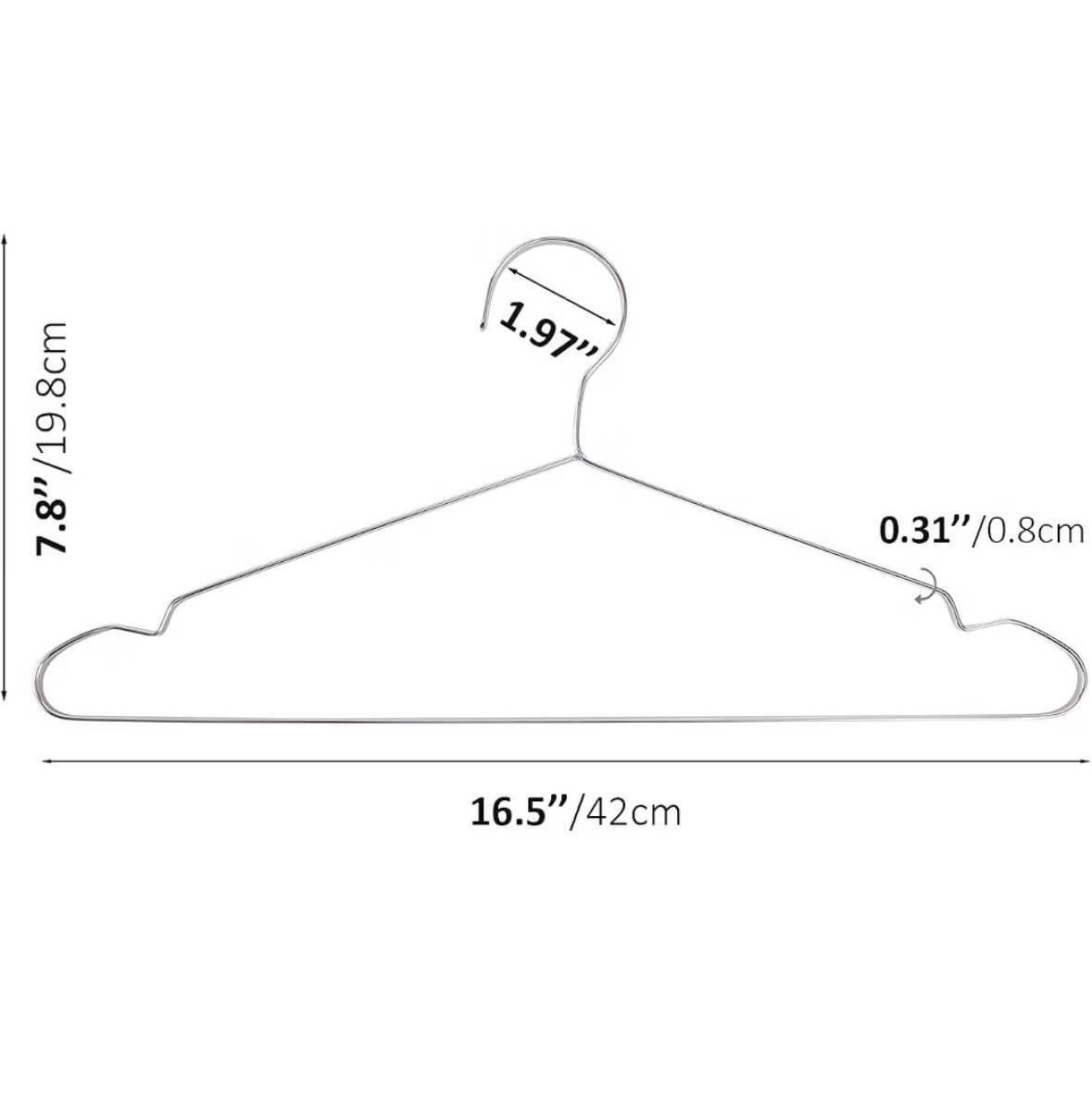 Heavy-Duty Stainless-Steel Hanger
5
Heavy-Duty Stainless-Steel Hanger
5
Project Preferences
Height flexibility
6
Configured Price
FRESH USA
Request Exact Quote + Delivery
Planning a custom uniform room? The final conveyor layout can be adapted around walls, columns, doors, ceiling height, loading points and employee distribution areas.
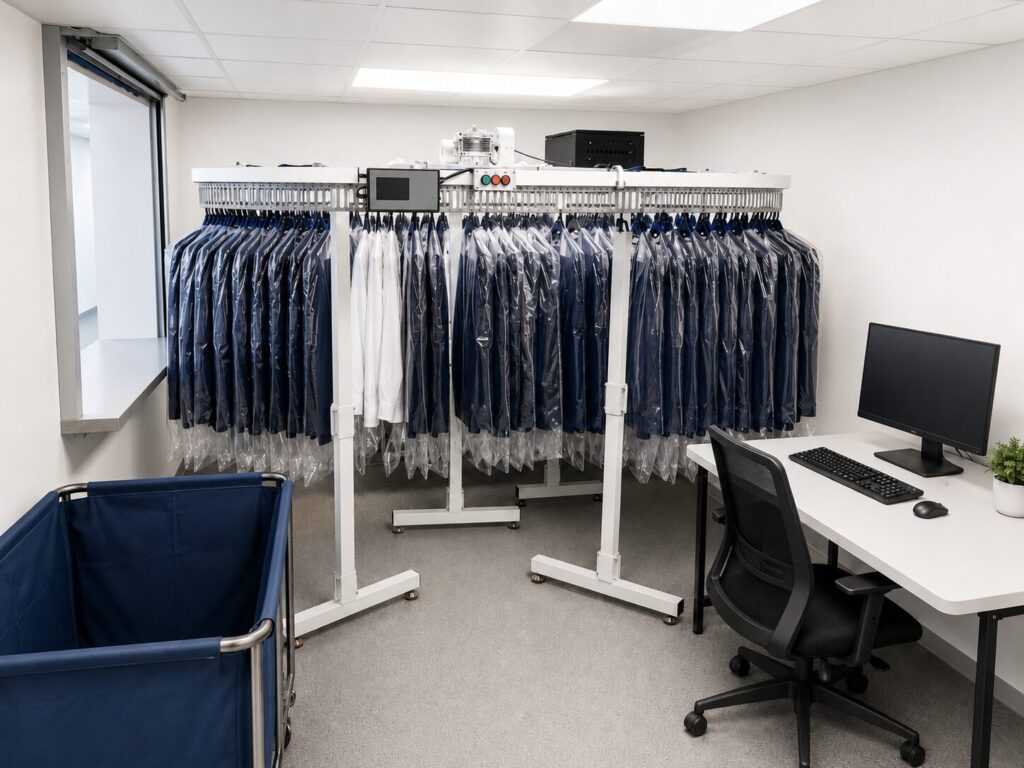
A uniform conveyor system is a powered garment storage system that moves uniforms directly to a loading, retrieval or employee distribution point. Garments remain suspended on hangers while the conveyor rotates the required section into position. Instead of employees walking through rows of fixed garment racks, the conveyor brings the uniforms to the operator. This reduces walking, manual searching and unnecessary handling while improving the organization of clean garments. Uniform conveyors are especially valuable in facilities that manage large employee populations, multiple departments, frequent shift changes or limited storage space. Uniform conveyor systems are a specialized application of our broader commercial garment conveyor systems.
Request a Custom Conveyor Layout
Traditional garment racks require permanent aisles between storage sections. Those aisles consume valuable floor space but do not store any garments.
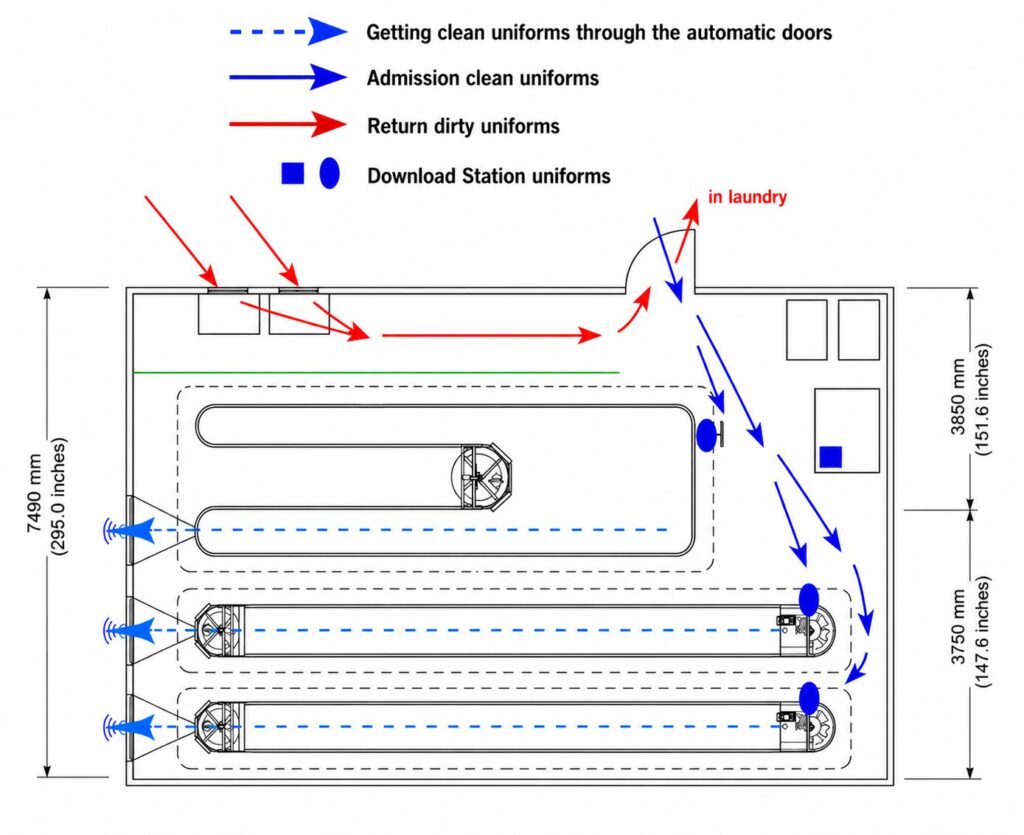
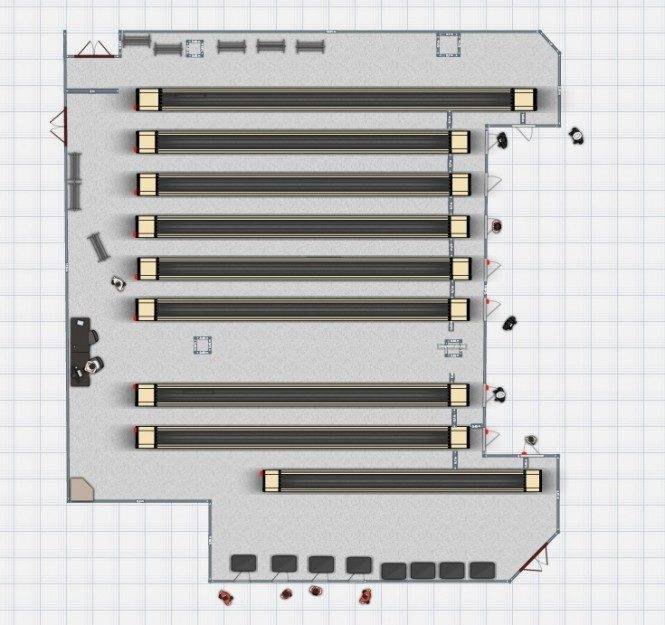
A custom conveyor layout reduces the need for multiple access aisles and can utilize more of the room’s width, length and ceiling height. This makes it possible to create high-density uniform storage inside both new and existing facilities. The final capacity depends on several factors, including:
| Fixed Garment Racks | Uniform Conveyor System |
|---|---|
| Multiple permanent aisles are required | Conveyor brings garments to the access point |
| Limited use of ceiling height | Custom systems can utilize available vertical space |
| Employees search manually | Required conveyor section moves into position |
| More walking between storage rows | Centralized garment loading and retrieval |
| Lower storage density | High-density uniform storage |
| Difficult to adapt around obstacles | Custom layouts can follow available room geometry |
| Expansion may require additional rooms | Modular expansion may be incorporated into the design |
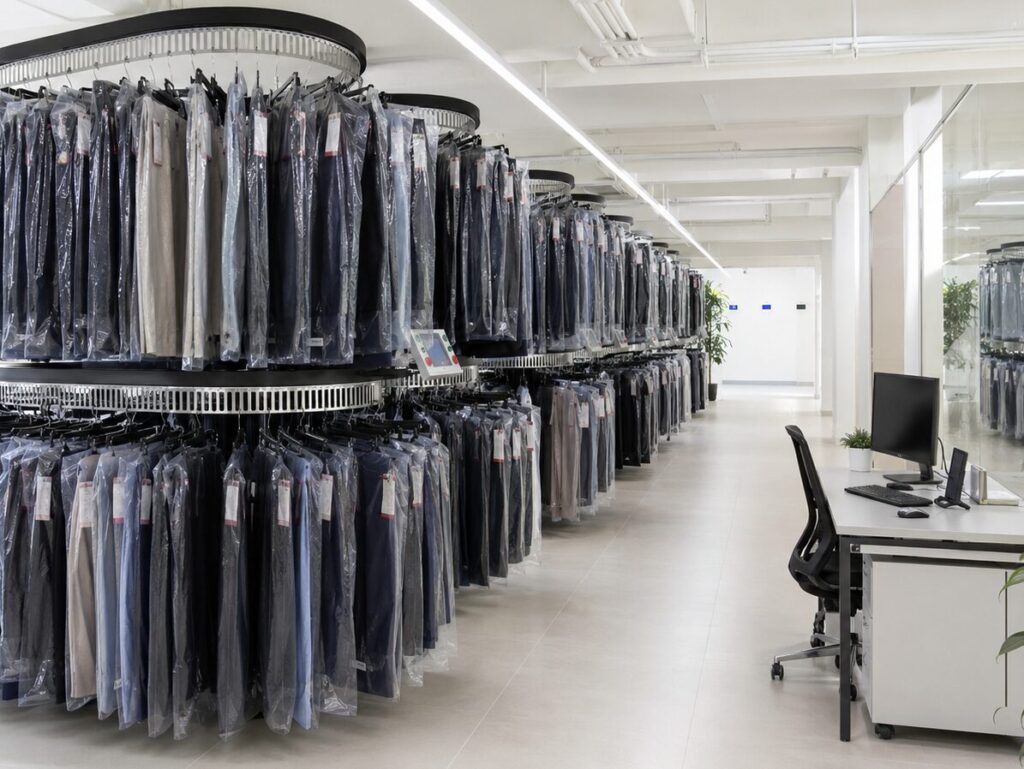
Store clean employee uniforms in an organized sequence while reducing the floor space required by traditional garment racks.
Move assigned garment sections directly to an operator, service counter or controlled employee distribution point.
Improve garment retrieval during busy shift changes when many employees require access within a short period.
Organize clean garments after processing and prepare them for employee distribution or delivery.
Convert an inefficient uniform room into a higher-density storage area without automatically requiring a larger facility.
Separate garments by department, employee group, location, size or other operational criteria.
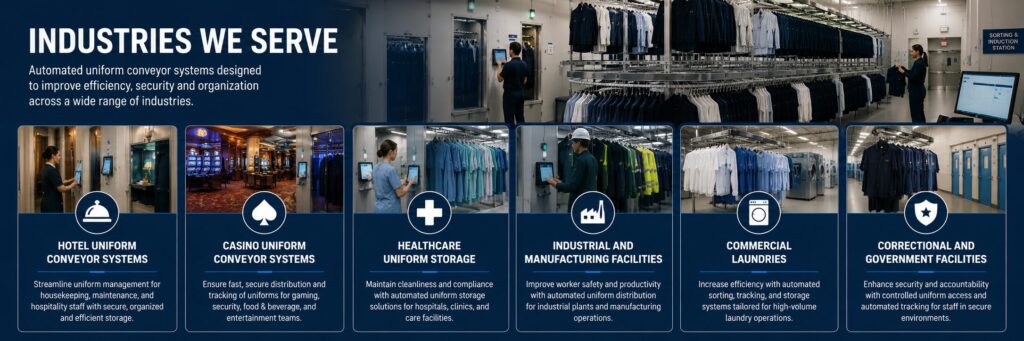
Organize uniforms for housekeeping, food service, engineering, maintenance, security, spa and front desk personnel. Custom conveyor layouts help hotels use back-of-house space more efficiently and improve access during shift changes.
Support large employee populations, multiple departments and continuous operating schedules. Casino projects may include several conveyors, multiple issue points and controlled employee access.
Store scrubs, laboratory coats, reusable gowns and other staff garments in an organized, high-density system designed around the facility’s laundry and distribution workflow.
Manage workwear, employee uniforms and wearable PPE for manufacturing plants, warehouses, utilities, food-processing operations and other industrial environments.
Use powered garment conveyors to organize processed uniforms before employee issue, customer delivery or route distribution.
Create controlled garment storage and distribution systems for facilities that require organized access, accountability and efficient use of secure space.
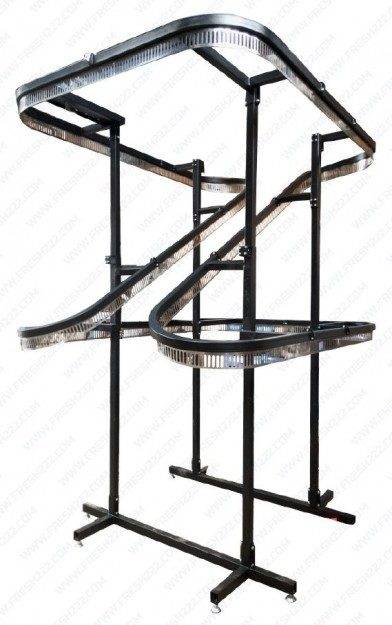
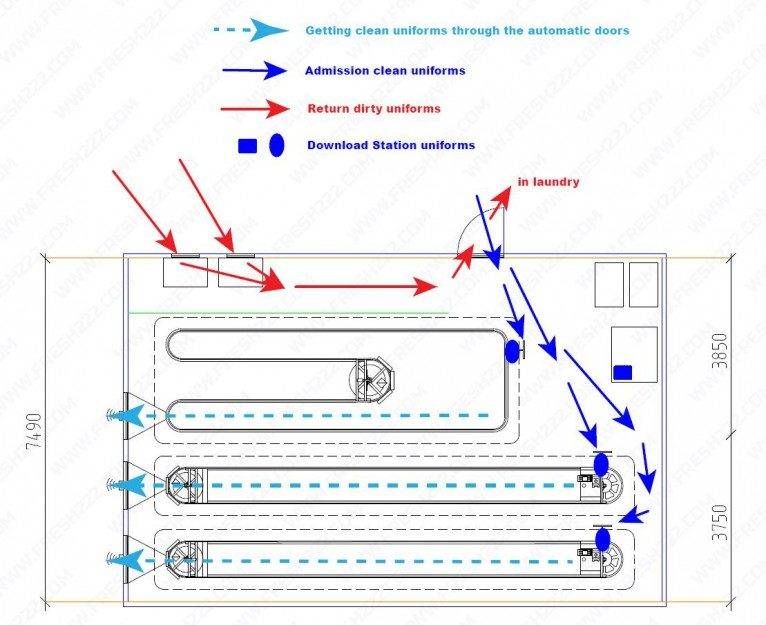
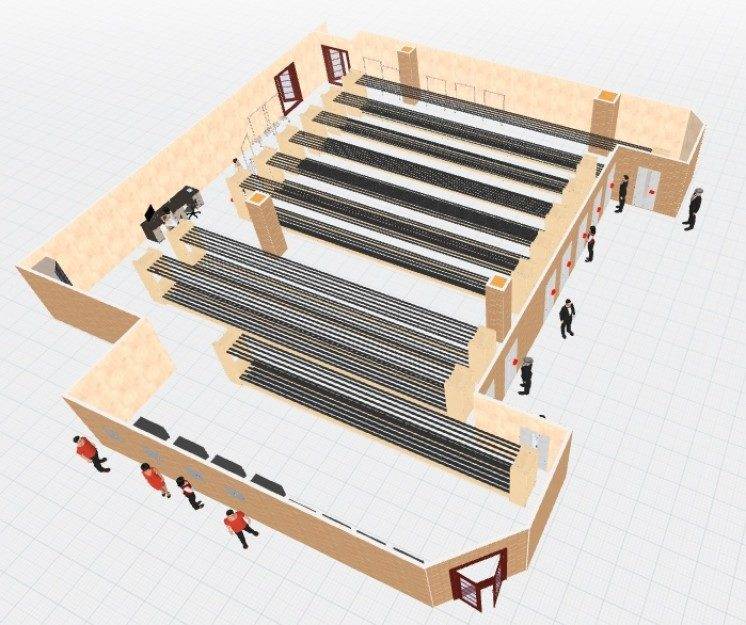
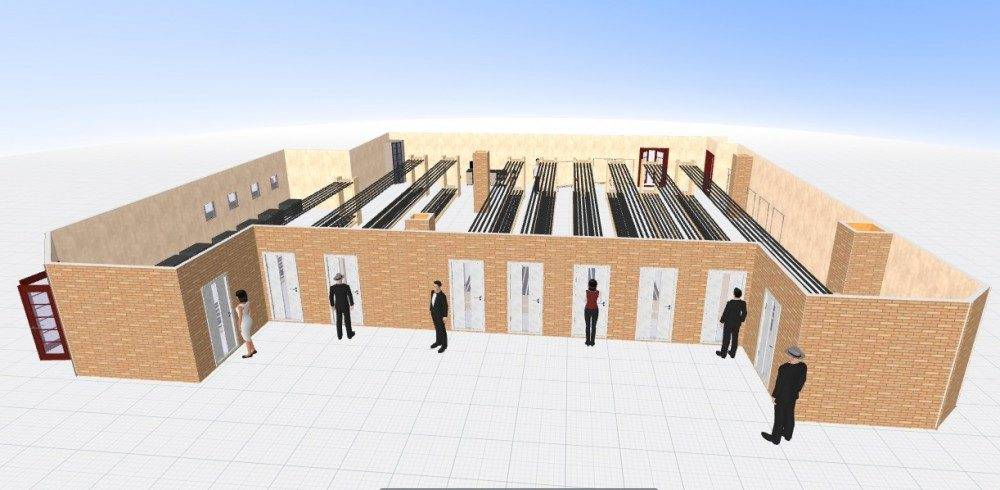
Uniform storage rooms are rarely identical. Room shape, ceiling height, doors, columns, utilities and employee traffic patterns all affect the final conveyor design. Fresh USA can design systems using configurations such as:
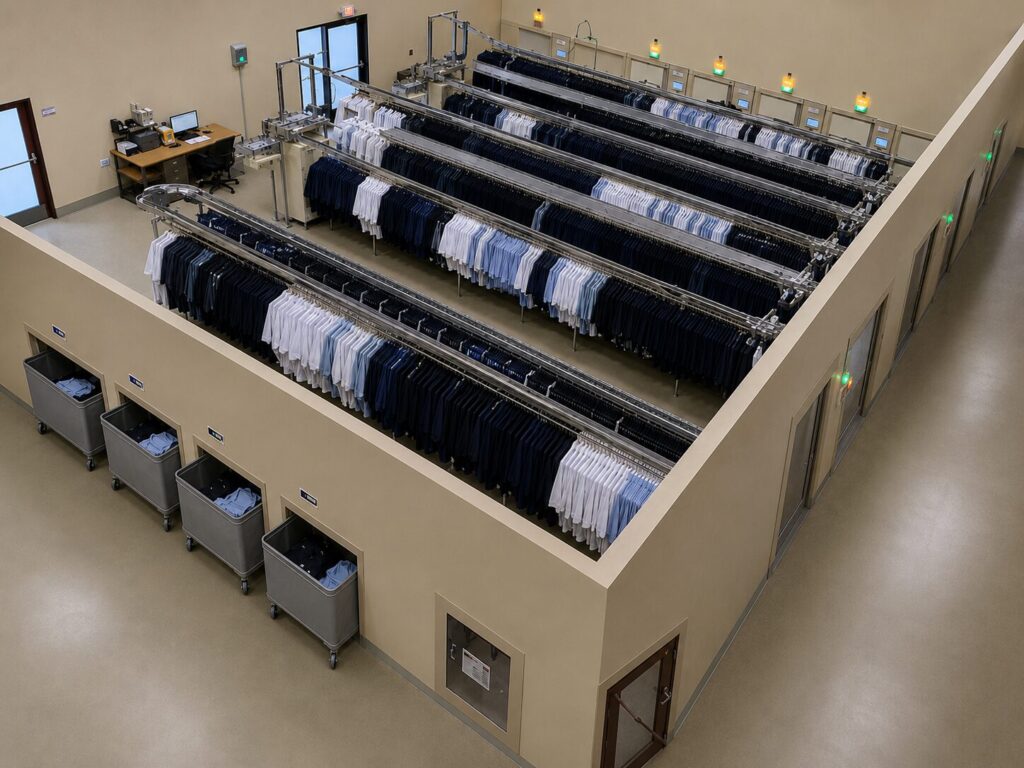
The conveyor may be supported by floor-mounted columns, adjustable-height supports, ceiling structures or another configuration appropriate for the project.






Processed garments are placed onto the conveyor and organized according to the facility’s preferred system, such as employee, department, garment type or assigned position.
The conveyor keeps uniforms suspended and organized while using the available storage area efficiently.
The operator activates the conveyor and brings the required garment section directly to the loading or distribution area.
Employees or uniform-room personnel retrieve garments without searching through multiple fixed storage aisles.
Used garments may be collected separately for laundry processing and later returned to the clean uniform conveyor.
A uniform conveyor does not require a complex tracking system to provide value. Many facilities use the conveyor as a standalone powered storage system controlled by an operator.
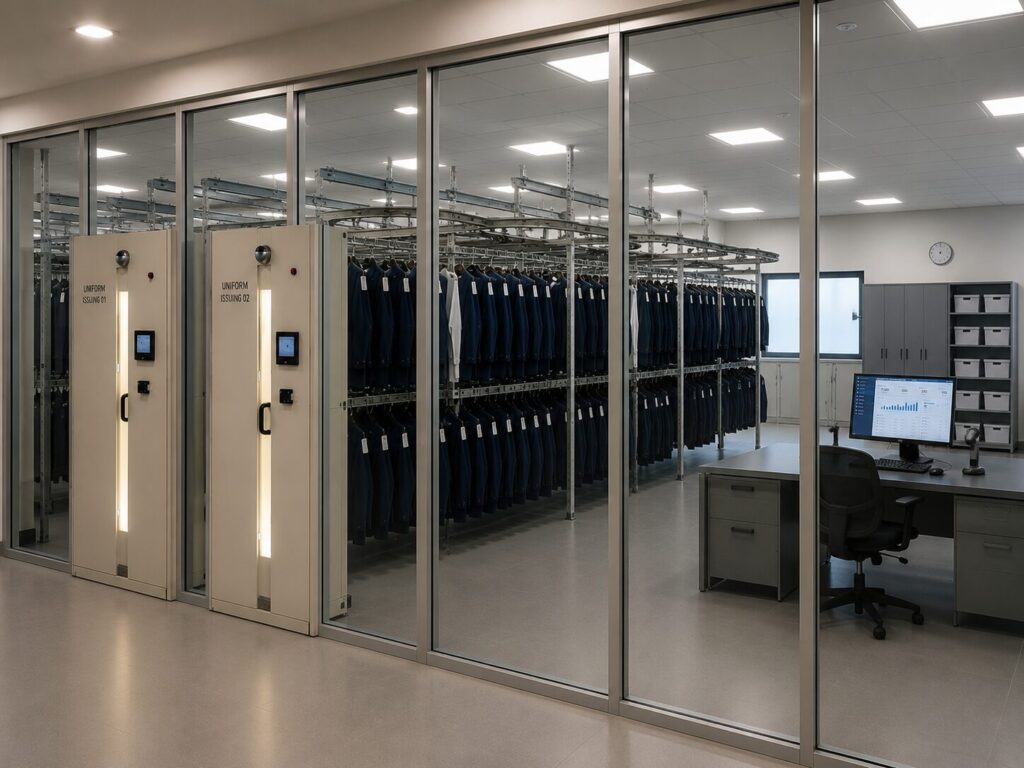
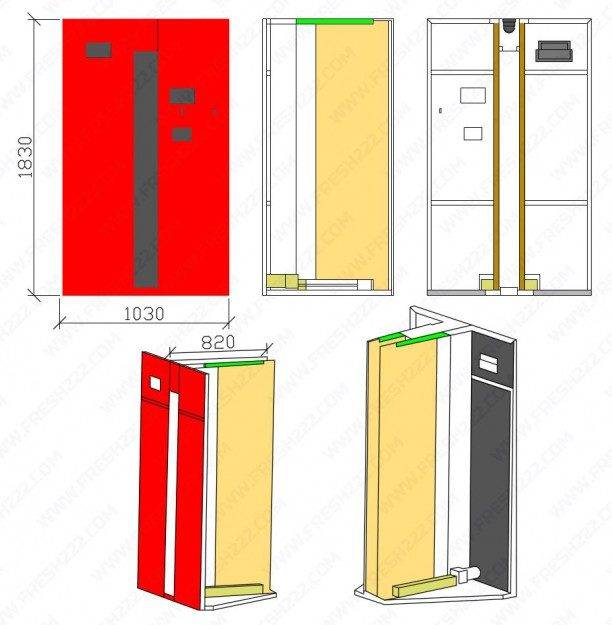
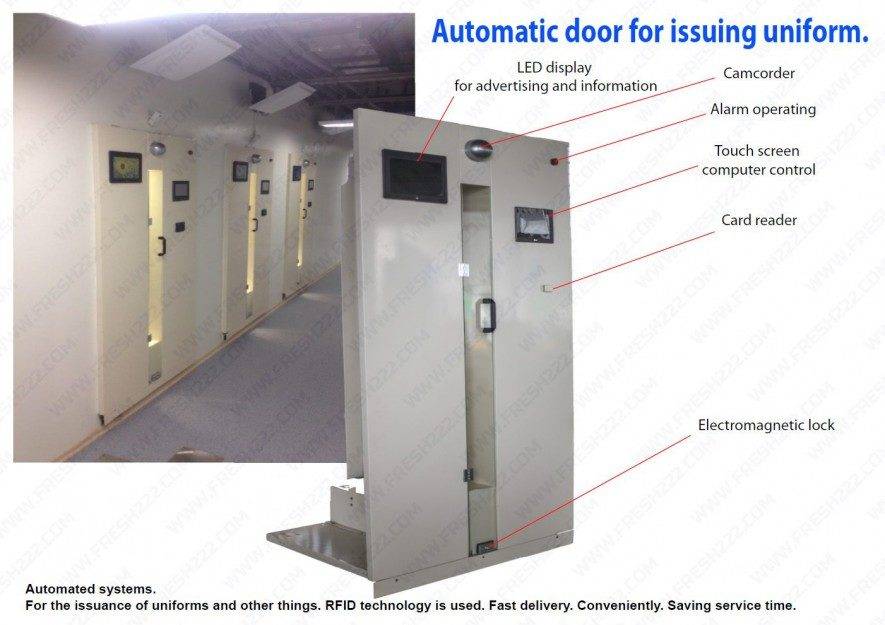
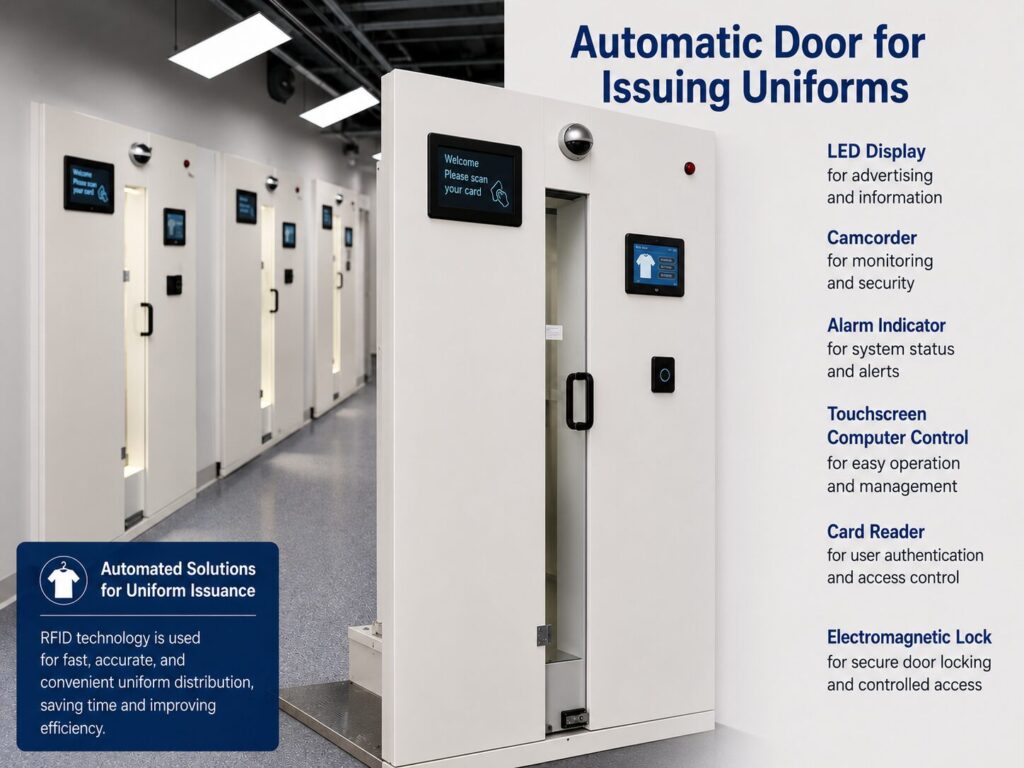
Facilities requiring additional automation can expand the system with selected features, including:
The level of automation can be selected according to the facility’s operational needs and budget. A project may begin with a conveyor-only system and be expanded later when required.
A conveyor should not be selected only by its overall length. The most effective system must be designed around the complete storage and distribution process. Our planning process considers:
A properly planned layout can improve both storage capacity and daily workflow. This is why every Fresh USA uniform conveyor project begins with an evaluation of the room and operating requirements.
Provide room dimensions, photographs, architectural drawings or a simple floor plan showing walls, doors, columns and ceiling height.
Tell us how many uniforms, employees, departments and daily shift changes the system must support.
Our team evaluates the available space and develops a recommended conveyor configuration.
We review the proposed layout, system capacity, controls, optional automation and installation requirements with your team.
The conveyor system is manufactured according to the approved project configuration.
Equipment is delivered to the project location. Installation service is available within the continental United States, and equipment can be supplied worldwide.
To prepare an initial recommendation, please provide as much of the following information as possible:
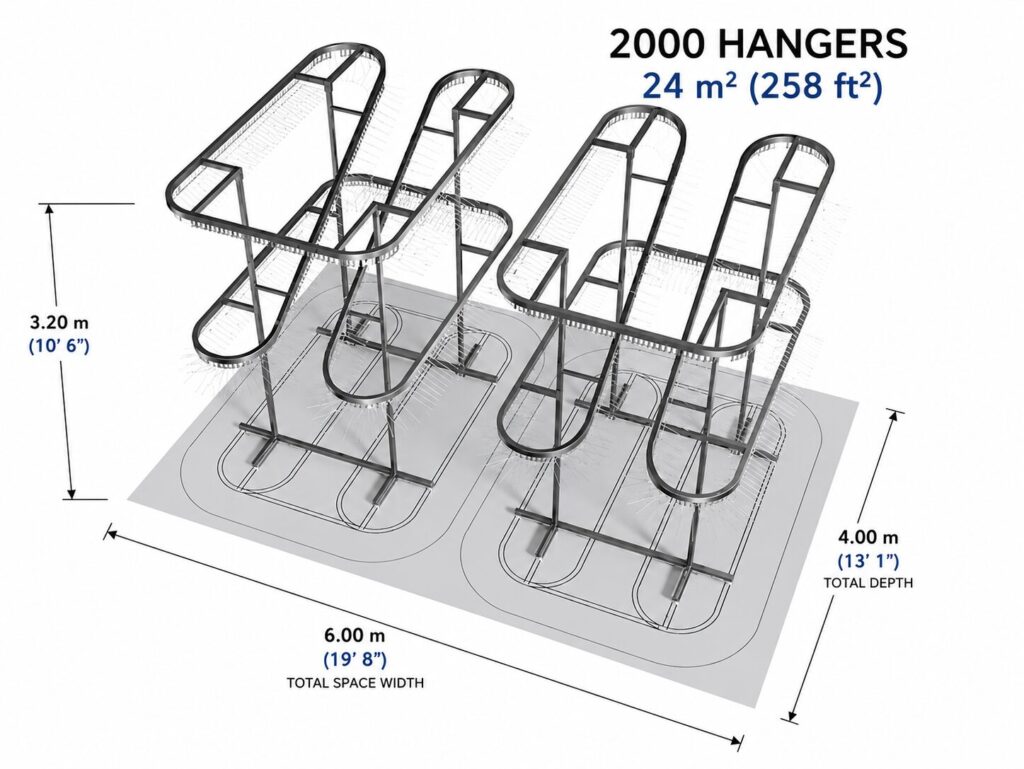
Architectural drawings are helpful but not required for the initial discussion. Clear room measurements, photographs and a basic sketch may be sufficient to begin.
Fresh USA develops complete garment storage and distribution solutions rather than offering only standard conveyor sizes. We combine conveyor engineering, custom layouts and optional automation to create a system suited to the facility’s actual needs.
Capacity depends on the conveyor path, number of levels, garment spacing, clothing length and available room dimensions. We calculate the recommended configuration after reviewing the project information.
Yes. Many projects are designed for existing rooms. The layout can be adapted around walls, columns, doors and other building conditions.
Where building conditions permit, a multi-level configuration can use vertical space that would otherwise remain unused.
Yes. Conveyor support structures can be designed with adjustable-height columns or another support method appropriate for the facility.
No. The conveyor can operate as a standalone powered garment storage system. RFID and software are optional additions.
Yes. Depending on the original design, RFID identification, employee authorization and software may be added as a later phase.
Yes. Custom conveyor paths can often be designed around columns and other fixed obstacles.
Yes. Large facilities may use multiple conveyor loops organized by department, employee group or distribution area.
Yes. Multiple loading, operator or employee distribution points can be considered during the design process.
Yes. Garments may be organized by department, employee, garment type, shift or another operating category.
Yes. Hotels and casinos are among the primary applications because they often manage large uniform inventories and frequent employee shift changes.
Yes. Uniform conveyors can store scrubs, laboratory coats, gowns and other reusable medical garments.
Installation service is available throughout the continental United States. Equipment supply and remote support are available for international projects.
Future expansion can often be incorporated into the original design. Available room space and building conditions should be reviewed during the planning stage.
Send us the room dimensions, ceiling height, photographs, required capacity and a description of the current uniform workflow. Our team will review the information and recommend the next steps.
Every project begins with a review of the available space and operational workflow. Our team will help determine the conveyor configuration that provides the required capacity while supporting efficient loading, storage and employee distribution. Send us your room dimensions, photographs, drawings and expected uniform capacity to begin the evaluation.
Request a Uniform Conveyor Proposal
For technical information about conveyor construction, dimensions and available equipment configurations, visit our Garment Conveyor Systems page.