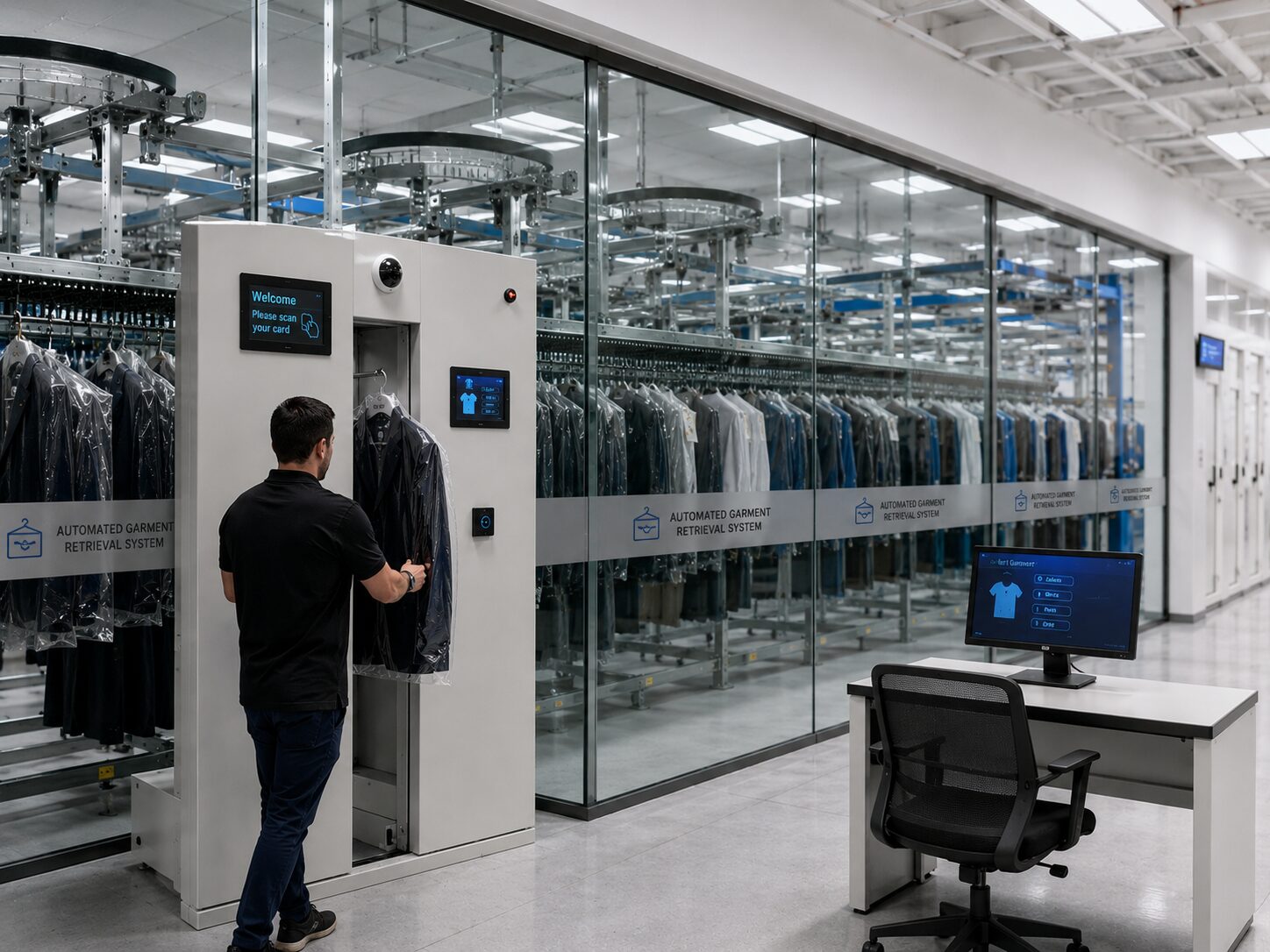
Need to find and retrieve a specific garment quickly from hundreds or thousands of stored items? An automated garment retrieval system identifies the required storage position and moves it directly to the operator, reducing manual searching, waiting time and handling errors.
These systems combine a commercial garment conveyor with numbered storage positions, automatic positioning, optional RFID or barcode identification and garment management software. They are designed for theaters, costume departments, hotels, casinos, healthcare facilities, industrial uniform rooms, commercial cloakrooms and other high-volume garment storage operations.
A basic powered conveyor moves garments forward or backward. An automated garment retrieval system can locate a selected garment, rotate the conveyor to the assigned position and present it at a designated loading or retrieval station.
Why Use an Automated Garment Retrieval System?
Manual garment storage becomes increasingly difficult as the number of uniforms, costumes, coats or other hanging items grows. Employees must walk between racks, read labels, search through garment groups and return items to the correct location.
An automated retrieval system brings the selected storage position to the operator. This creates a centralized workflow and can significantly reduce unnecessary walking and manual searching.
The system is particularly useful when a facility must:
- Store hundreds or thousands of hanging garments
- Retrieve specific garments quickly
- Reduce waiting lines at issue or collection points
- Control which employees receive particular uniforms
- Record garment issue and return transactions
- Organize garments by employee, department, production or event
- Improve accountability for valuable uniforms or costumes
- Use limited storage space more efficiently
If garments only need to be moved around a track, a standard motorized conveyor may be sufficient. When specific items must be identified, located and presented automatically, a garment retrieval system provides a more efficient solution.
What Is an Automated Garment Retrieval System?
An automated garment retrieval system is a motorized storage solution that assigns garments to numbered or electronically identified conveyor positions. When an operator selects an employee, garment number, order, costume or storage position, the control system rotates the conveyor and stops the selected position at the retrieval station.

Depending on the project, the system may include:
- A heavy-duty garment conveyor
- Numbered garment storage cells
- Motor and control panel
- Position sensors or an encoder
- Automatic position search
- Touchscreen or computer workstation
- RFID employee identification
- RFID garment tags
- Barcode scanning
- Garment location software
- Issue and return records
- Access control integration
Automation can be simple or extensive. A small theater may only require numbered position search, while a hotel, casino or industrial facility may need employee identification, uniform assignment, transaction records and management reports.
How Automated Garment Retrieval Works
1. A Garment Is Assigned to a Storage Position
Each garment, uniform set, costume or order is assigned to a numbered conveyor cell or hanger position. The position can be entered manually, scanned from a barcode or associated with an RFID-tagged garment.
2. The Garment Record Is Stored
The garment location may be recorded in the control panel or optional management software. The record can include the employee, department, costume name, order number, garment type, issue status and assigned conveyor position.
3. The Operator Searches for the Garment
The operator enters a position number, employee ID, garment number, order number or another search value. In employee-based systems, an RFID badge, card or wristband can identify the authorized user.
4. The Conveyor Moves Automatically
The control system rotates the conveyor and positions the selected numbered location at the designated loading or retrieval station.
5. The Garment Is Issued or Returned
The operator removes or replaces the garment. Where management software is used, the transaction can be recorded automatically or confirmed through the operator interface.
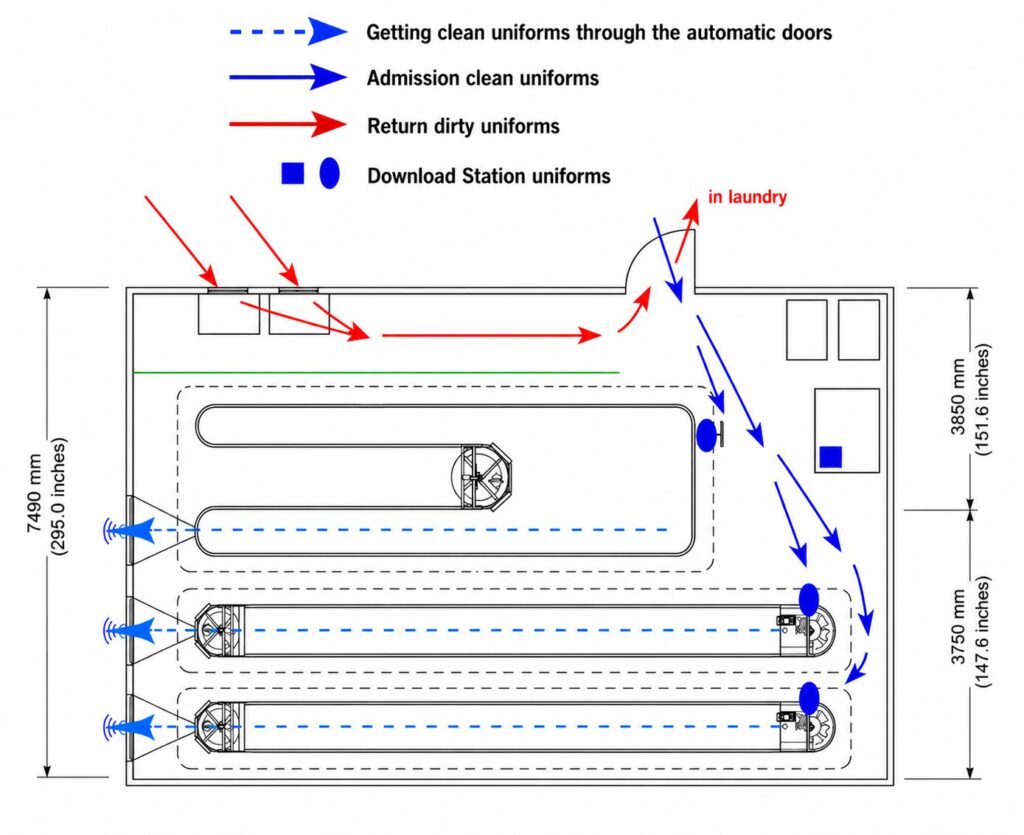
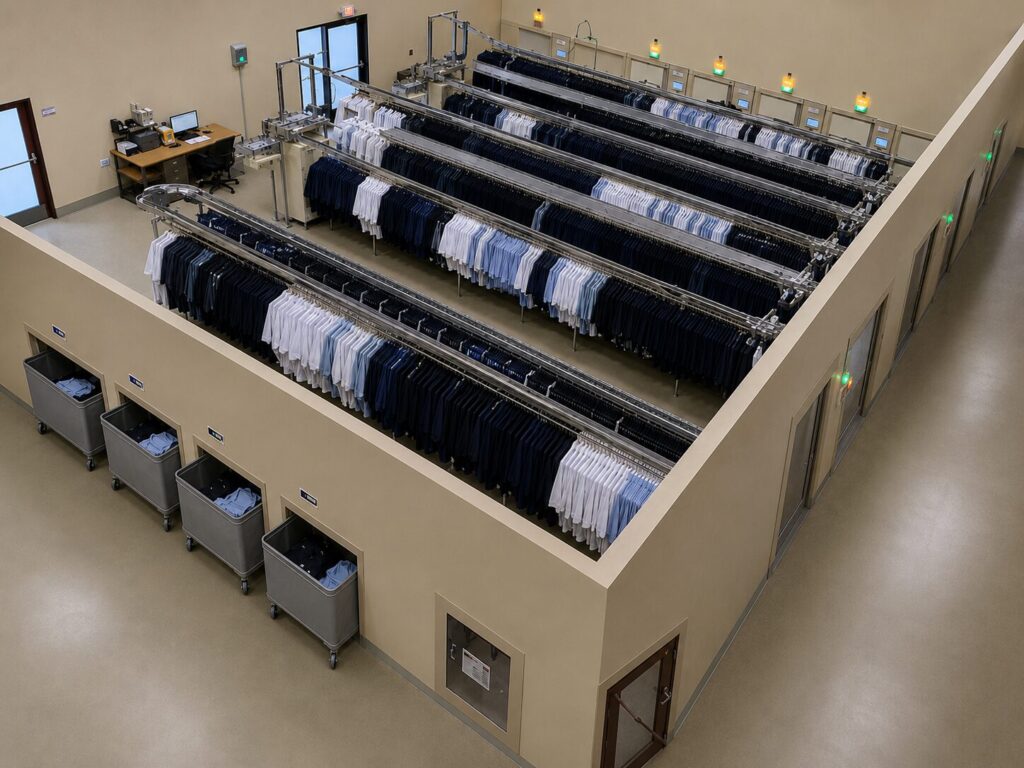
Automated Garment Retrieval System Components
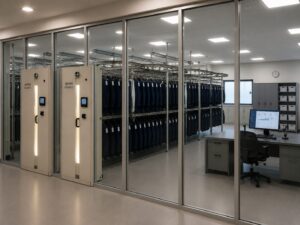
Commercial Garment Conveyor
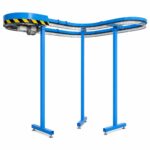
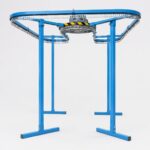
The conveyor provides the physical storage and movement platform. It can be designed in I, H, L, U, X, Z or custom configurations to fit the room and required capacity.
Motor and Control Panel
The drive system moves the conveyor forward or backward. Controls may range from simple push buttons to automatic positioning and computer-controlled operation.
Position Detection
Sensors, encoders or other positioning components allow the system to identify conveyor movement and stop at the selected storage location.
Numbered Storage Positions
Each cell or storage location receives a unique number. This provides the foundation for automatic position search, even when RFID or software is not required.
Operator Workstation
The system can be controlled through physical buttons, a keypad, touchscreen or Windows computer, depending on the selected automation level.
RFID Identification
RFID cards, badges or wristbands can identify employees and authorized users. RFID tags attached to garments can also support garment identification and tracking.
Barcode Integration
Barcodes can be used to identify garments, customer orders, costumes or laundry transactions where barcode-based workflows are already in place.
Management Software
Optional software can store garment locations, employee records, issue history, return history, system activity and operational reports.
Available Levels of Garment Retrieval Automation
| Automation Level | Operation | Typical Features | Best For |
|---|---|---|---|
| Powered Conveyor | Manual movement | Forward, reverse, push buttons, foot pedal or remote control | Simple garment transport and low-volume retrieval |
| Position Search | Automatic numbered retrieval | Numbered cells, position controller and automatic stopping | Theaters, costume rooms, cloakrooms and uniform storage |
| Identification-Assisted Retrieval | Search by employee, garment or order | RFID badge, RFID garment tag, barcode scanner or touchscreen | Hotels, casinos, healthcare and industrial uniform rooms |
| Managed Retrieval System | Software-controlled issue and return | Garment database, employee authorization, transaction history and reports | High-volume uniform and garment management operations |
The correct automation level depends on the number of garments, retrieval frequency, required transaction history, employee workflow and available project budget.
Automatic Position Search
Automatic position search is often the most practical form of garment conveyor automation. Each storage cell receives a number, and the operator enters the required position into the controller.
The conveyor then moves the selected location to the retrieval station. This eliminates the need to hold a movement button while watching hundreds of garments pass the operator.
Automatic positioning is useful for:
- Costume and wardrobe departments
- Hotel and casino uniform rooms
- Industrial workwear storage
- Commercial cloakrooms
- Dry-cleaning order storage
- Police, fire and government uniform rooms
Position search can operate as a standalone control function or as part of a larger RFID and software-based management system.
RFID Garment Identification and Retrieval
RFID can be added when the system must identify an employee, garment or storage transaction automatically. The technology is optional and is selected according to the workflow.
Employee Identification
An employee presents an RFID card, badge or wristband. The software identifies the employee, displays assigned garments and can move the corresponding position to the issue station.
Garment Identification
A garment RFID tag can connect the physical item to its electronic record. The system may record the garment number, employee assignment, department, storage position and issue status.
Access Authorization
The system can limit access to authorized users or departments. This is useful when different employee groups, costume collections or high-value garments share the same storage area.
Transaction History
Software can record who received or returned a garment, the date and time of the transaction and the selected storage position.
RFID is not required for every conveyor. Numbered position search may be more suitable where the main goal is simply to retrieve garments quickly.
Garment Retrieval Software
Garment retrieval software creates a searchable connection between the conveyor position and the person, garment, costume or order stored at that location.
Depending on the project, software functions may include:
- Employee and department records
- Garment and costume records
- Conveyor position assignment
- Search by name, number, badge or barcode
- Uniform issue and return history
- Authorized user management
- Garment status and availability
- Transaction reports
- Manual conveyor movement
- Automatic retrieval commands
- Multiple conveyor management
- Integration with other facility systems
The software configuration is developed around the actual workflow rather than forcing every facility to use the same operating process.
Where Automated Garment Retrieval Systems Are Used
Theaters and Costume Departments
Theaters, opera houses, television studios and film production facilities may store thousands of costumes. Automatic position search allows wardrobe personnel to retrieve a selected costume without searching through long rows of fixed racks.
Hotels and Casinos
Hotels and casinos can use automated garment retrieval to store employee uniforms by person, department, job function or uniform type. Optional employee identification and software can support controlled issue and return.
Healthcare Facilities
Hospitals and healthcare organizations can manage scrubs, lab coats, uniforms and other workwear while maintaining organized departmental storage.
Industrial and Manufacturing Facilities
Industrial plants can store employee uniforms, protective clothing and workwear in a compact centralized area. Automated retrieval helps reduce congestion during shift changes.
Commercial Cloakrooms and Coat Checks
Numbered retrieval can accelerate coat collection at theaters, event venues, restaurants, clubs and other high-volume cloakrooms.
Commercial Laundries and Dry Cleaners
Garments can be stored by order number, customer, route or account. Barcode scanning and automatic position search help operators retrieve completed orders efficiently.
Police, Fire and Government Facilities
Uniforms and specialized clothing can be organized by employee, department or equipment assignment with optional access authorization and transaction history.
Automated Retrieval vs Fixed Garment Racks
| Feature | Fixed Garment Racks | Automated Garment Retrieval |
|---|---|---|
| Garment Access | Employees walk through storage aisles | The selected position moves to the operator |
| Search Method | Manual visual search | Number, name, RFID or barcode search |
| Storage Density | Multiple walking aisles are usually required | Garments circulate through a centralized retrieval point |
| Retrieval Time | Depends on rack location and employee experience | Repeatable automatic positioning |
| Transaction Records | Usually manual | Optional software-based history |
| Employee Authorization | Controlled by room access | Optional user and garment-level authorization |
| Expansion | Additional racks and aisles may be required | Modular conveyor layouts can often be extended |
| Relocation | Racks can be moved individually | Modular conveyor systems can be disassembled and reinstalled |
Fixed racks remain practical for small collections and low retrieval volumes. Automated retrieval becomes more valuable as garment quantity, issue frequency and labor requirements increase.
Benefits of Automated Garment Retrieval
- Faster retrieval: selected garments move to a centralized station.
- Reduced walking: operators do not need to search through multiple storage aisles.
- Improved organization: each garment or order can be assigned to a defined position.
- Higher storage density: room space can be used more efficiently than many traditional rack layouts.
- Fewer retrieval errors: number, RFID or barcode search directs the system to the assigned position.
- Employee accountability: optional software records issue and return activity.
- Flexible automation: facilities can select basic positioning or a complete management system.
- Expandable design: modular systems can be configured for changing storage requirements.
- Custom room layouts: conveyors can be designed around walls, columns, doors and available ceiling height.
- International compatibility: motors and controls can be configured for local electrical standards.
Can an Existing Garment Conveyor Be Automated?
Some existing garment conveyors can be upgraded with automatic positioning, sensors, a new control panel or management software. However, retrofitting depends on the existing motor, track condition, control system, mechanical structure and compatibility with position-sensing components.
Before recommending an upgrade, we normally require:
- Manufacturer and model information
- Overall conveyor dimensions
- Motor and control panel photographs
- Electrical specifications
- Track and chain condition
- Existing position numbering
- Required automation functions
- A short video showing current operation
For older, heavily worn or undocumented equipment, replacing the system may be more practical than attempting extensive automation of incompatible components.
Custom Conveyor Layouts and Storage Capacity
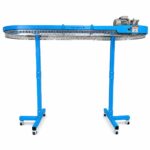
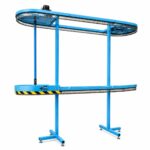
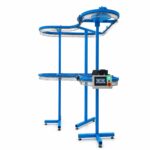
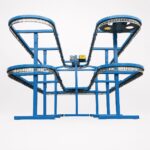
The retrieval system can be built around straight, curved and multi-level conveyor layouts. Available configurations include I-shaped, H-shaped, L-shaped, U-shaped, X-shaped, Z-shaped and custom track paths.
Final capacity depends on:
- Available room length and width
- Ceiling height
- Garment type and thickness
- Hanger spacing
- Single-level or multi-level construction
- Doors, columns and permanent obstacles
- Required operator area
- Motor and loading-station position
For capacities, equipment footprints and preliminary room clearances, review our garment conveyor dimensions in feet and inches.
Heavy-Duty Modular Construction
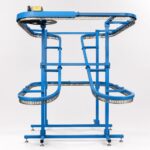
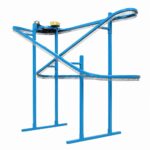
Fresh USA garment retrieval systems are built on modular commercial conveyor platforms designed for demanding storage applications.
- Heavy-duty steel structure
- Durable moving components
- Modular track construction
- Custom room configurations
- Single-level and multi-level systems
- Numbered components for straightforward assembly
- Ability to disassemble and reinstall at another location
- Optional automatic search and software integration
- Custom motor and electrical configurations
- Five-year limited warranty on the structure and moving mechanical components, excluding the electric motor
The modular design allows systems to be shipped efficiently, assembled in numbered stages and adapted to the approved building layout.
Electrical and Control Options
Motors and controls can be configured for the electrical standard of the installation country. Available configurations may include 110–120 V, 208–240 V and 380–415 V systems, 50 or 60 Hz, with the appropriate single-phase or three-phase arrangement for the approved design.
Control options may include:
- Forward and reverse push buttons
- Foot pedal control
- Wireless remote control
- Emergency stop
- Numbered position search
- Touchscreen operation
- Computer software control
- RFID or barcode identification
- Employee access authorization
How to Plan an Automated Garment Retrieval Project
To recommend the correct system, we need to understand both the room and the operational workflow.
Please provide:
- Installation address and country
- Room length, width and ceiling height
- Door, column and obstacle locations
- Required number of garments
- Garment type, length and approximate thickness
- Current storage and retrieval process
- Number of daily issue and return transactions
- Number of operators and retrieval stations
- Required RFID, barcode or software functions
- Available electrical service
- Photographs, floor plans or a basic room sketch
Based on this information, we can recommend the conveyor shape, capacity, automation level, control method and preliminary room layout.
Request a Custom Retrieval System
View Commercial Garment Conveyors
Frequently Asked Questions
How does an automated garment retrieval system work?
Each garment is assigned to a numbered or electronically identified conveyor position. The operator searches for the garment, employee, order or position, and the control system rotates the selected location to the retrieval station.
Is RFID required for automatic garment retrieval?
No. A system can retrieve garments using numbered positions without RFID. RFID is optional and is useful when employee identification, garment tracking, access control or transaction history is required.
What is the difference between an automated garment conveyor and a regular powered conveyor?
A regular powered conveyor moves forward or backward under operator control. An automated system can locate a selected position and stop it automatically at the loading or retrieval station.
Can the system retrieve garments by employee name or badge?
Yes. With appropriate software and employee identification, the system can connect an employee record to one or more assigned garment positions.
Can barcodes be used instead of RFID?
Yes. Barcode scanning can be used to identify garments, customer orders, costumes or transaction records. The best identification method depends on the facility workflow.
How many garments can one system store?
Capacity depends on the conveyor layout, available room, ceiling height, garment thickness and hanger spacing. Standard and custom systems can be designed for hundreds or thousands of storage positions.
Can several garment conveyors work together?
Yes. Multiple conveyors can be managed as separate systems or integrated through a common control and software platform, depending on the project requirements.
Can the system be expanded later?
Many modular installations can be expanded or upgraded, provided the room, support structure and original design allow additional track, storage cells or automation components.
Can an existing conveyor be connected to new software?
Possibly. Compatibility depends on the motor, controls, position detection and communication interface. Technical information, photographs and an operating video are required before an upgrade can be evaluated.
Do you provide custom conveyor layouts?
Yes. Systems can be designed around room dimensions, doors, columns, workflow, storage capacity and available ceiling height.
Do you provide installation?
Professional installation is available in the continental United States. Equipment can also be supplied worldwide with assembly documentation and remote technical support.
Where can I find complete conveyor specifications?
Visit our Commercial Garment Conveyors page for construction details, layouts, dimensions, assembly information, applications and custom engineering options.
Where can I review pricing?
Visit our Commercial Garment Conveyor Pricing page for preliminary equipment pricing and ordering information.