You do not need to replace every existing process at once. A project can begin with one immediate problem and expand as your facility’s needs grow.
Tell Us What You Need to Improve
What Problem Is Your Facility Trying to Solve?

Healthcare technology should make work easier for employees, not add another complicated system to manage. Our solutions are designed around practical questions:
- How can staff find medical equipment without searching multiple rooms?
- How can a hospital quickly inventory hundreds of mobile assets?
- How can wheelchairs and walkers be protected at building exits?
- How can employee uniforms be stored and retrieved faster?
- How can uniform issue and return transactions be recorded?
- How can selected exits be monitored for at-risk patients or residents?
- How can access to restricted rooms and departments be controlled?
- How can several processes operate through one coordinated technology platform?
Fresh USA evaluates the workflow first and then selects the appropriate combination of equipment, software and automation.
Hospital Asset Tracking and Medical Equipment Inventory
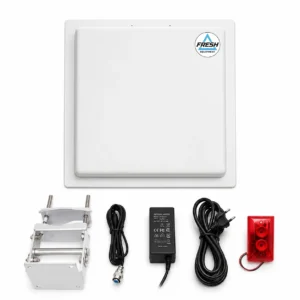
Portable medical equipment rarely remains in one place. Wheelchairs, monitors, carts, rehabilitation equipment, tools and electronic devices move between departments, patient rooms, storage areas and service locations. When there is no reliable hospital asset tracking process, an available item may appear to be missing simply because it was moved without being recorded. Employees search for equipment, departments order unnecessary replacements and important assets may not be available where they are expected. An RFID-based medical equipment tracking system can help identify and inventory tagged assets without scanning each barcode individually.
Assets That Can Be Identified and Managed
- Wheelchairs and transport chairs
- Walkers and rollators
- Portable monitoring equipment
- Rehabilitation devices
- Medical and supply carts
- Tools and maintenance equipment
- Computers, tablets and electronics
- Emergency equipment
- Reusable containers and supplies
- Other valuable or frequently moved assets
Fast Inventory with Handheld RFID Readers
A handheld RFID reader can identify multiple tagged assets within its reading area. Employees can verify the contents of a room, storage area or department without locating every item and scanning it individually. This approach is well suited for periodic inventory, departmental audits and locating tagged equipment within a defined area.
Fixed Readers at Selected Locations
Fixed RFID readers can be installed at selected doors, storage areas or checkpoints. When tagged equipment passes through the monitored reading zone, the system can record the event or activate an alarm according to the approved configuration. The correct design depends on whether your facility needs inventory, exit protection, movement records or continuous location visibility. These are different requirements and should not be treated as the same system. Explore RFID Asset Tracking
Healthcare Uniform Management and Automated Storage
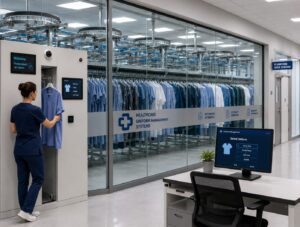
Uniform rooms often become a hidden operational bottleneck. Scrubs, lab coats, housekeeping uniforms and other garments must be received, organized, assigned, stored, found and returned. Manual racks may work for a small operation. As the number of employees and garments grows, staff may spend more time searching through rows of uniforms, resolving assignment errors and reorganizing storage. Fresh USA designs healthcare uniform management systems that combine high-capacity garment conveyors with automatic position search and optional employee and garment identification.
Custom Uniform Conveyor Systems
A motorized garment conveyor uses the available room height and perimeter more effectively than rows of fixed racks. The conveyor moves the required storage position directly to the operator. Systems can be designed in different configurations, including:
- Straight conveyor layouts
- L-shaped and U-shaped systems
- H-shaped conveyor configurations
- Single-level and multi-level storage
- Custom layouts around walls, doors and columns
- Ceiling-mounted or floor-supported systems
From Simple Storage to Full Uniform Tracking
Not every facility needs the same level of automation. A conveyor can operate with numbered storage positions and automatic position retrieval without tracking every garment. For more advanced operations, the system can include:
- Employee RFID card or badge identification
- RFID or barcode garment identification
- Uniform issue and return records
- Employee and department assignments
- Clean and returned garment workflows
- Inventory and laundry management software
The objective is simple: reduce searching, improve storage capacity and make uniform distribution easier to control. Explore Healthcare Uniform Management Systems
Wheelchair and Walker Anti-Theft Protection
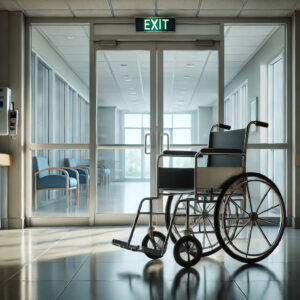
A wheelchair may be moved from an entrance to a patient room, transferred to another department or taken outside during discharge. Walkers, rollators and rehabilitation devices follow similar movement patterns. Without protection at selected exits, mobility equipment can leave the facility without staff awareness. Even when an item is not intentionally stolen, it may still become unavailable to the department that owns it. Fresh USA provides RFID anti-theft systems that can detect protected equipment near a monitored doorway or exit.
How the System Works
- An RFID tag is attached to the wheelchair, walker or other protected asset.
- An RFID reader monitors the configured area near the exit.
- The reader detects the protected tag when it enters the reading zone.
- The system activates the configured audible and visual alarm.
- Optional software or wireless notification equipment can be added when required.
Passive UHF RFID tags do not require a battery in every wheelchair or walker. This makes the system practical for facilities managing a large number of mobility devices.
Equipment That Can Be Protected
- Manual wheelchairs
- Transport chairs
- Walkers
- Rollators
- Shower and commode chairs
- Rehabilitation equipment
- Patient transport devices
- Medical carts and other mobile assets
The reading area must be tested and adjusted for the doorway, surrounding materials, tag position and required detection zone. View Wheelchair and Walker Protection
Patient and Resident Wander Management

Hospitals, memory care communities, assisted living facilities and behavioral health departments may care for individuals who are at risk of entering restricted areas or leaving a protected zone without staff awareness. A patient or resident wander management system can provide an additional layer of awareness at selected exits and controlled areas. Depending on the approved facility workflow, a solution may include:
- Individually assigned wearable credentials
- Monitoring of selected doors and exits
- Audible and visual alarms
- Identification of the assigned credential
- Authorized staff override credentials
- Access-control integration
- Event records and reporting
- Wireless alarm notification options
The system can be configured to monitor defined locations without claiming continuous room-by-room tracking throughout the entire building. Continuous real-time location requires a different infrastructure and must be specified separately. Wander management technology is a supplemental safety tool. It does not replace staff supervision, individual risk assessment, approved care plans, clinical procedures or emergency response policies. Discuss a Patient or Resident Safety System
Healthcare Access Control for Restricted Areas
Healthcare facilities contain areas that should not be accessible to every employee, visitor or contractor. These may include medication rooms, laboratories, equipment storage, uniform rooms, maintenance areas, administrative offices and employee entrances. Fresh USA provides RFID access control readers, credentials and software that can be integrated with doors, gates and other controlled entry points. Access control functions may include:
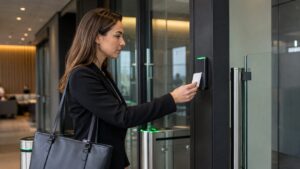
- Employee RFID cards and key fobs
- Door and gate readers
- Individual access permissions
- Department-based access levels
- Schedules and time restrictions
- Entry and exit event records
- Long-range vehicle access
- Integration with existing actuators and control equipment
Existing employee credentials may sometimes be used, but compatibility depends on the credential frequency, technology and data format. Explore Access Control Systems
One Facility. Multiple Connected Workflows.
Healthcare organizations do not always need a separate identification platform for every application. When the technical requirements are compatible, employee credentials, RFID tags, readers, software and access-control components can support multiple workflows across the same facility. A combined project may include:
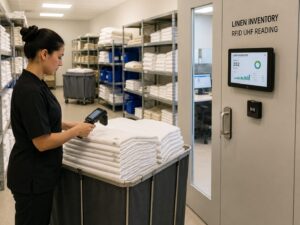
- Employee identification
- Uniform storage and retrieval
- Uniform issue and return tracking
- Hospital asset inventory
- Wheelchair and walker protection
- Restricted-area access control
- Employee parking access
- Selected exit monitoring
- Centralized event and transaction records
This does not mean forcing every department into one oversized system. It means designing compatible modules around real operational requirements.
Choose the Right Level of Healthcare Technology Solutions
The most expensive or complicated system is not automatically the best solution.
Level 1: Stand-Alone Protection
A reader, protected RFID tags and a local alarm can monitor a selected doorway without requiring a large software deployment.
Level 2: RFID Inventory
Handheld readers and inventory software can identify tagged assets and help employees conduct faster room or departmental inventories.
Level 3: Fixed Checkpoint Monitoring
Readers installed at defined locations can automatically detect tagged assets when they pass through selected zones.
Level 4: Integrated Workflow
RFID, employee credentials, conveyors, software and access control can be connected to support multiple operational processes.
Level 5: Continuous Real-Time Location
Continuous building-wide location requires additional infrastructure and a separately designed RTLS solution. It should only be proposed when the required accuracy and operational benefit justify the additional system complexity. Fresh USA helps determine which level is appropriate before equipment is selected.
Healthcare and Senior Care Facilities We Support
- Hospitals and medical centers
- Senior living communities
- Assisted living facilities
- Memory care communities
- Skilled nursing facilities
- Rehabilitation centers
- Behavioral health facilities
- Psychiatric departments
- Clinics and outpatient centers
- Medical laboratories
- Healthcare laundries and uniform departments
Why Work with Fresh USA?
- RFID hardware, software and automation from one solution provider
- Custom system design based on the actual workflow
- Healthcare uniform conveyor engineering
- Fixed and handheld RFID reader options
- Stand-alone and software-based configurations
- Asset tracking, inventory and anti-theft capabilities
- Access-control and alarm integration
- Solutions that can begin small and expand later
- Remote technical support and system documentation
- Supply and project support in the United States and worldwide
Start with the Problem, Not the Product
You do not need to know which RFID reader, tag, antenna or software package is required before contacting us. Describe the operational problem:
- What cannot your staff find?
- What equipment is being lost or removed?
- Where does the workflow slow down?
- Which doors or exits require monitoring?
- How many employees, assets or garments are involved?
- What information should the system record?
We will evaluate your requirements and recommend the right healthcare technology solutions for your facility. Request a Custom Healthcare Solution
Information Needed for a Preliminary Recommendation
To help us understand your project, please provide:
- Facility name and installation address
- Type of healthcare or senior care facility
- A clear description of the current problem
- Types and approximate number of assets or uniforms
- Number of employees, patients or residents involved
- Number of monitored doors, exits or departments
- Room dimensions or available floor plans
- Photographs of the proposed installation areas
- Existing employee badge or access-control technology
- Required reports, alerts or software integration
Frequently Asked Questions
What are healthcare technology solutions?
Healthcare technology solutions are systems designed to improve facility operations, equipment visibility, employee workflows, access control and safety. They may include RFID asset tracking, medical equipment inventory, automated uniform storage, wheelchair protection and monitored exit systems.
Can RFID help staff find medical equipment?
Yes. A handheld RFID reader can help employees identify tagged equipment within a room or department. Fixed readers can detect tagged equipment at selected checkpoints. Continuous room-level location requires a separately designed RTLS system.
Can one system track both wheelchairs and walkers?
Yes. Suitable RFID tags can be attached to wheelchairs, walkers, rollators, transport chairs and other mobility equipment. The same monitored exit can detect different categories of protected assets.
Do passive RFID tags need batteries?
No. Passive RFID tags receive power from the reader’s radio signal when they enter its reading field. They do not require individual charging or routine battery replacement.
Is RFID required for an automated uniform conveyor?
No. A uniform conveyor can use numbered storage positions and automatic position retrieval without RFID. RFID or barcode tracking can be added when employee assignments, garment identification or transaction records are required.
Can existing employee badges be used?
Possibly. Compatibility depends on the badge frequency, credential type, data format and required system functions. Existing credentials must be evaluated before the system is designed.
Is an exit alarm the same as real-time asset tracking?
No. An exit alarm detects a tagged asset inside a defined reading area. Real-time tracking continuously estimates an asset’s location and requires additional infrastructure.
Can healthcare systems be expanded later?
Yes. A facility may begin with one doorway, one department or one workflow and add readers, tags, software functions or additional locations as requirements grow.